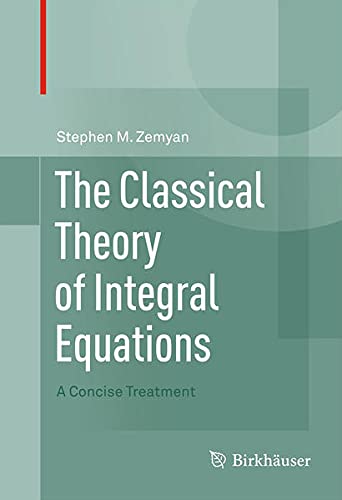
The Classical Theory of Integral Equations [electronic resource] : A Concise Treatment / by Stephen M. Zemyan.
Material type: TextPublisher: Boston, MA : Birkhäuser Boston : Imprint: Birkhäuser, 2012Description: XIII, 344 p. online resourceContent type:
 - text
- computer
- online resource
- 9780817683498
- 515.352 23
- QA372
| Item type | Current library | Collection | Call number | Status | Date due | Barcode | Item holds | |
|---|---|---|---|---|---|---|---|---|
 eBook
eBook
|
e-Library | EBook | Available |
Preface -- Introduction -- Fredholm Integral Equations of the Second Kind (Separable Kernel) -- Fredholm Integral Equations of the Second Kind (General Kernel) -- Volterra Integral Equations -- Differential and Integrodifferential Equations -- Nonlinear Integral Equations -- Singular Integral Equations -- Systems of Integral Equations -- Appendix A 2010 Mathematics Subject Classification 45-XX Integral Equations -- Appendix B Specialized Vocabularies and Sample Translations -- Bibliography -- Index.
The Classical Theory of Integral Equations is a thorough, concise, and rigorous treatment of the essential aspects of the theory of integral equations. The book provides the background and insight necessary to facilitate a complete understanding of the fundamental results in the field. With a firm foundation for the theory in their grasp, students will be well prepared and motivated for further study. Included in the presentation are: • A section entitled Tools of the Trade at the beginning of each chapter, providing necessary background information for comprehension of the results presented in that chapter; • Thorough discussions of the analytical methods used to solve many types of integral equations; • An introduction to the numerical methods that are commonly used to produce approximate solutions to integral equations; • Over 80 illustrative examples that are explained in meticulous detail; • Nearly 300 exercises specifically constructed to enhance the understanding of both routine and challenging concepts; • Guides to Computation to assist the student with particularly complicated algorithmic procedures. This unique textbook offers a comprehensive and balanced treatment of material needed for a general understanding of the theory of integral equations by using only the mathematical background that a typical undergraduate senior should have. The self-contained book will serve as a valuable resource for advanced undergraduate and beginning graduate-level students as well as for independent study. Scientists and engineers who are working in the field will also find this text to be user friendly and informative.