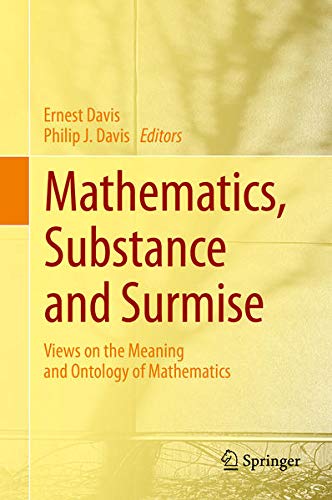
Mathematics, Substance and Surmise [electronic resource] : Views on the Meaning and Ontology of Mathematics / edited by Ernest Davis, Philip J. Davis.
Material type: TextPublisher: Cham : Springer International Publishing : Imprint: Springer, 2015Edition: 1st ed. 2015Description: VI, 379 p. 35 illus., 23 illus. in color. online resourceContent type:
 - text
- computer
- online resource
- 9783319214733
- 510.9 23
- QA21-27
| Item type | Current library | Collection | Call number | Status | Date due | Barcode | Item holds | |
|---|---|---|---|---|---|---|---|---|
 eBook
eBook
|
e-Library | EBook | Available |
Introduction -- Hardy, Littlewood, and polymath, (Martin and Pease) -- Experimental Computation as an Ontological Game Changer: The Impact of Modern Mathematical Computation Tools on the Ontology of Mathematics (Bailey and Borwein).- Mathematical Products (Davis).-How Should Robots Think about Space? (Azzouni) -- Mathematics and its Applications (Berlinski) -- Nominalism: The Nonexistence of Mathematical Objects (Azzouni) -- An Aristotelian Approach to Mathematical Ontology (Gillies) -- Let G be a Group (Lützen) -- From the Continuum to Large Cardinals (Stillwell) -- Mathematics at Infinity (Gray) -- Mathematics and Language (Avigad) -- Mathematics as Language (Ross) -- Mathematics as Multimodal Semiotics (O'Halloran) -- Problems in Philosophy of Mathematics: A View from Cognitive Science (Piantadosi) -- Beliefs about the Nature of Numbers (Rips) -- What Kind of Thing Might Number Become? (Sinclair) -- Enumerated Entities in Public Policy and Governance (Verran).
The seventeen thought-provoking and engaging essays in this collection present readers with a wide range of diverse perspectives on the ontology of mathematics. The essays address such questions as: What kind of things are mathematical objects? What kinds of assertions do mathematical statements make? How do people think and speak about mathematics? How does society use mathematics? How have our answers to these questions changed over the last two millennia, and how might they change again in the future? The authors include mathematicians, philosophers, computer scientists, cognitive psychologists, sociologists, educators, and mathematical historians; each brings their own expertise and insights to the discussion. Contributors to this volume: Jeremy Avigad Jody Azzouni David H. Bailey David Berlinski Jonathan M. Borwein Ernest Davis Philip J. Davis Donald Gillies Jeremy Gray Jesper Lützen Ursula Martin Kay L. O’Halloran Alison Pease Steven T. Piantadosi Lance J. Rips Micah T. Ross Nathalie Sinclair John Stillwell Helen Verran.