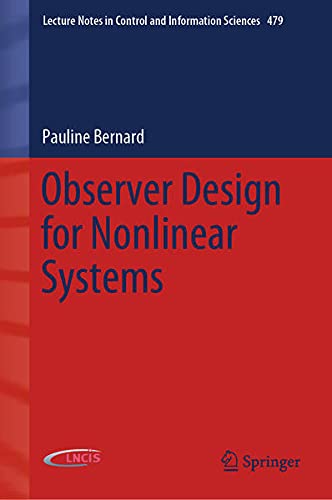
Observer Design for Nonlinear Systems [electronic resource] / by Pauline Bernard.
Material type: TextSeries: Lecture Notes in Control and Information Sciences ; 479Publisher: Cham : Springer International Publishing : Imprint: Springer, 2019Edition: 1st ed. 2019Description: XI, 187 p. 76 illus., 9 illus. in color. online resourceContent type:
 - text
- computer
- online resource
- 9783030111465
- 629.8 23
- TJ212-225
| Item type | Current library | Collection | Call number | Status | Date due | Barcode | Item holds | |
|---|---|---|---|---|---|---|---|---|
 eBook
eBook
|
e-Library | EBook | Available |
Chapter 1. Nonlinear Observability and the Observer Design Problem -- Part I: Normal Forms and Their Observers -- Chapter 2. Introduction -- Chapter 3. State-affine Normal Forms -- Chapter 4. Triangular Forms -- Part II: Transformation into a Normal Form -- Chapter 5. Introduction -- Chapter 6. Transformations into State-affine Normal Forms -- Chapter 7. Transformation into Triangular Forms -- Part III: Expression of the Dynamics of the Observer in the System Coordinates -- Chapter 8. Motivation and Problem Statement -- Chapter 9. Around Problem 8.1 : Augmenting an Injective Immersion into a Diffeomorphism -- Chapter 10. Around Problem 8.2 : Image Extension of a Diffeomorphism -- Chapter 11. Generalizations and Examples.
Observer Design for Nonlinear Systems deals with the design of observers for the large class of nonlinear continuous-time models. It contains a unified overview of a broad range of general designs, including the most recent results and their proofs, such as the homogeneous and nonlinear Luenberger design techniques. The book starts from the observation that most observer designs consist in looking for a reversible change of coordinates transforming the expression of the system dynamics into some specific structures, called normal forms, for which an observer is known. Therefore, the problem of observer design is broken down into three sub-problems: • What are the available normal forms and their associated observers? • Under which conditions can a system be transformed into one of these forms and through which transformation? • How can an inverse transformation that recovers an estimate in the given initial coordinates be achieved? This organisation allows the book to structure results within a united framework, highlighting the importance of the choice of the observer coordinates for nonlinear systems. In particular, the first part covers state-affine forms with their Luenberger or Kalman designs, and triangular forms with their homogeneous high-gain designs. The second part addresses the transformation into linear forms through linearization by output injection or in the context of a nonlinear Luenberger design, and into triangular forms under the well-known uniform and differential observability assumptions. Finally, the third part presents some recently developed methods for avoiding the numerically challenging inversion of the transformation. Observer Design for Nonlinear Systems addresses students and researchers looking for an introduction to or an overview of the state of the art in observer design for nonlinear continuous-time dynamical systems. The book gathers the most important results focusing on a large and diffuse literature on general observer designs with global convergence, and is a valuable source of information for academics and practitioners.