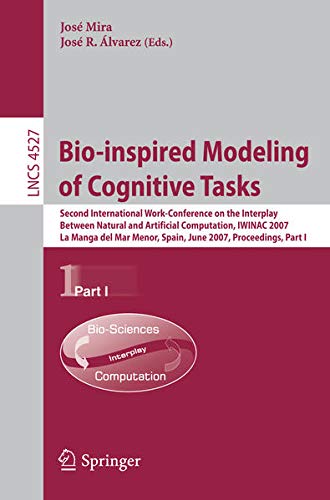
Second International Work-Conference on the Interplay between Natural and Artificial Computation, IWINAC 2007, La Manga del Mar Menor, Spain, June 18-21, 2007 : proceedings / José Mira, José R. Álvarez (eds.).
Material type: TextSeries: Lecture notes in computer science ; 4527-4528.Publication details: Berlin ; New York : Springer, ©2007.Description: 1 online resource (2 volumes) : illustrationsContent type:
 - text
- computer
- online resource
- 9783540730538
- 3540730532
- 3540730524
- 9783540730521
- 3540730540
- 9783540730545
- Natural computation -- Congresses
- Artificial intelligence -- Congresses
- Neural networks (Computer science) -- Congresses
- Computational neuroscience -- Congresses
- Cognition -- Computer simulation -- Congresses
- Brain -- Computer simulation -- Congresses
- Biological models
- Artificial intelligence
- Cognition
- Problem solving
- Models, Biological
- Artificial Intelligence
- Bionics -- methods
- Cognition
- Problem Solving
- Calcul naturel -- Congrès
- Intelligence artificielle -- Congrès
- Réseaux neuronaux (Informatique) -- Congrès
- Neurosciences informatiques -- Congrès
- Cognition -- Simulation par ordinateur -- Congrès
- Cerveau -- Simulation par ordinateur -- Congrès
- Modèles biologiques
- Intelligence artificielle
- Cognition
- Résolution de problème
- artificial intelligence
- cognition
- Artificial intelligence
- Bionics -- methods
- Cognition
- Problem solving
- Biologically-inspired computing
- Neural networks (Computer science)
- Computational neuroscience
- Cognition -- Computer simulation
- Brain -- Computer simulation
- Models, Biological
- Informatique
- Problem solving
- Cognition
- Biological models
- Artificial intelligence
- Natural computation
- Brain -- Computer simulation
- Cognition -- Computer simulation
- Computational neuroscience
- Neural networks (Computer science)
- computerwetenschappen
- computer sciences
- bioinformatics
- computational science
- beeldverwerking
- image processing
- machine vision
- patroonherkenning
- pattern recognition
- algoritmen
- algorithms
- computeranalyse
- computer analysis
- kunstmatige intelligentie
- artificial intelligence
- Information and Communication Technology (General)
- Informatie- en communicatietechnologie (algemeen)
- 573.8/60113 22
- QP376 .I595 2007aeb
- 2007 H-211
- QH 324.8
- TP18-532
- DAT 500f
| Item type | Current library | Collection | Call number | Status | Date due | Barcode | Item holds | |
|---|---|---|---|---|---|---|---|---|
 eBook
eBook
|
e-Library | eBook LNCS | Available |
Includes bibliographical references and author index.
pt. I. Bio-inspired modeling of cognitive tasks -- pt. 2. Nature inspired problem-solving methods in knowledge engineering.
Print version record.
The Semantic Gap ThereisasetofrecurrentproblemsinAIandneurosciencewhichhaverestricted their progress from the foundation times of cybernetics and bionics.
These pr- lems have to do with the enormous semantic leap that exists between the ont- ogy of physical signals and that of meanings.
Between physiologyand cognition.
Between natural languageand computer hardware.
We encounter this gap when we want to formulate computationally the cognitive processes associated with reasoning, planning andthe controlofactionand, infact, allthe phenomenology associated with thought and language.
All "bio-inspired" and "interplay" movement between the natural and ar-?cial, into which our workshop (IWINAC)?ts, faces this same problem every two years
We know how to model and reproduce those biological processes that areassociatedwith measurablephysicalmagnitudes and, consequently, we know howto designandbuild robotsthatimitate the correspondingbehaviors. Onthe other hand, we have enormous di?culties in understanding, modeling, formal- ing and implementing all the phenomenology associatedwith the cognition?eld.
We do not know the language of thought.
We mask our ignorance of conscience with the term emergentism.