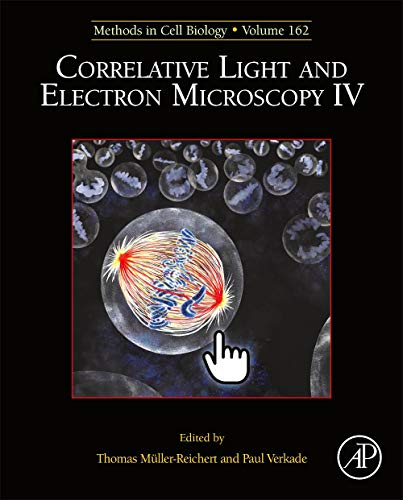
Correlative light and electron microscopy IV / edited by Thomas Müller-Reichert, Paul Verkade.
Material type: TextSeries: Methods in cell biology ; v. 162.Publisher: Cambridge, MA : Academic Press, 2021Description: 1 online resourceContent type:
 - text
- computer
- online resource
- 9780128220597
- 0128220597
- 570.2823 23
- QH212.E4 C67 2021
| Item type | Current library | Collection | Call number | Status | Date due | Barcode | Item holds | |
|---|---|---|---|---|---|---|---|---|
 eBook
eBook
|
e-Library | eBook Elsevier | Available |
Online resource; title from PDF title page (viewed August 16, 2021).
Abstract: Correlative light and electron microscopy (CLEM) combines the strengths of light microscopy (LM) and electron microscopy (EM) to pin-point and visualize cellular or macromolecular structures. However, there are many different imaging modalities that can be combined in a CLEM workflow, creating a vast number of combinations that can overwhelm new-comers to the field. Here, we offer a conceptual framework to help guide the decision-making process for choosing the CLEM workflow that can best address your research question, based on the answer to five questions.