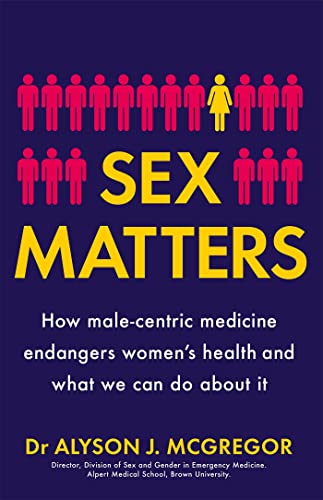
Sex matters : how male-centric medicine endangers women's health and what we can do about it / Alyson J. McGregor, MD, MA, FACEP.
Material type: TextPublisher: New York : Go / Hachette Books, 2020Copyright date: 2020Edition: First editionDescription: xvi, 254 pages ; 24 cmContent type:
 - text
- unmediated
- volume
- 9781529405927
- How male-centric medicine endangers women's health and what we can do about it
- Women's health services
- Women -- Health and hygiene
- Sexism in medicine
- Discrimination in medical care
- Sex factors in disease
- Women's Health
- Women's Health Services
- Sex Factors
- Sexism
- Sexisme en medecine
- Discrimination dans les soins medicaux
- Maladies -- Facteurs sexuels
- HEALTH & FITNESS / Women's Health
- HEALTH & FITNESS / Health Care Issues
- HEALTH & FITNESS / Diseases / Immune & Autoimmune
- Discrimination in medical care
- Sexism in medicine
- Women -- Health and hygiene
- Women's health services
- RA564.85 .M435 2020
- WA 309.1
| Item type | Current library | Call number | Status | Date due | Barcode | Item holds | |
|---|---|---|---|---|---|---|---|
 Book
Book
|
Library | 61x-2020 (Browse shelf(Opens below)) | Checked out | 25/12/2025 | AT-ISTA#002790 |
Includes bibliographical references (pages 221-236) and index.
Introduction -- Part One. How we got here. Modern medicine is male-centric medicine -- Sex is more than skin deep -- Part Two. The six biggest issues facing women's health today. Women's hearts (and brains) break differently -- Drugs for different bodies: The female side of pharmaceuticals -- "Honey, it's all in your head": Women's intuition versus women's imagination -- A deeper sensitivity: The female relationship to pain -- Beyond hormonal: Female biochemistry and hormone therapy -- A new perception: Gender, culture, and identity medicine -- Part Three. Where we're headed and what you can do. A changing conversation: The future of sex and gender research in medicine -- Your voice, your medicine: How to have helpful conversations with your providers -- Afterword -- Acknowledgments -- Appendix A. Your personal medical reconciliation (Med Rec) -- Appendix B. Quick reference questions.
Exposes that all medical models -- in research and practice -- are male-centric and shows how the biological, biochemical, psychological, and neurological differences between men and women affect issues such as preventative care, emergency care, drug prescriptions, and pain management. Also looks at how race, class, and gender identity are disproportionately affected by this.