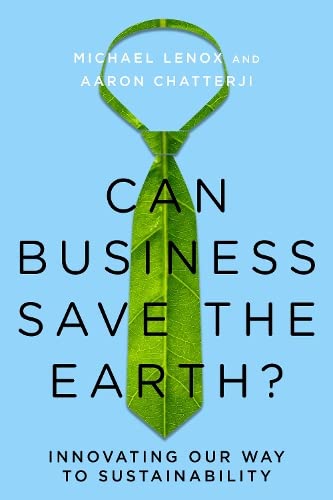
Can business save the Earth? : innovating our way to sustainability / Michael Lenox and Aaron Chatterji.
Material type: TextPublisher: Stanford, California : Stanford Business Books, an imprint of Stanford University Press, [2018]Copyright date: ©2018Description: 1 online resource (xii, 185 pages) : illustrationsContent type:
 - text
- computer
- online resource
- 9781503606197
- 1503606198
- Business enterprises -- Environmental aspects
- Technological innovations -- Environmental aspects
- Industrial management -- Environmental aspects
- Sustainable development
- BUSINESS & ECONOMICS -- Industries -- General
- Business enterprises -- Environmental aspects
- Industrial management -- Environmental aspects
- Sustainable development
- Technological innovations -- Environmental aspects
- 338.9/27 23
- HD30.255 .L46 2018eb
| Item type | Current library | Collection | Call number | Status | Date due | Barcode | Item holds | |
|---|---|---|---|---|---|---|---|---|
 eBook
eBook
|
e-Library | EBSCO Business | Available |
Includes bibliographical references (pages [153]-174) and index.
Business as savior -- Innovator as genius -- Manager as hero -- Investor as visionary -- Customer as king -- System as catalyst.
The only way business can save the earth and set us on a path to sustainability is if we can harness the power of an entire system of inventors, companies, investors, government, activists, and customers. Taking a systemic perspective that goes beyond the typical dichotomy of business and government, the authors outline how each type of player can help us to address the current environmental crisis.
Increasingly, business leaders are tasked with developing new products, services, and business models that minimize environmental impact while driving economic growth. It's a tall order--and a call that is only getting louder. In Can Business Save the Earth?, Michael Lenox and Aaron Chatterji explain just how the private sector can help. Many believe that markets will inevitably demand sustainable practices and force them to emerge. But Lenox and Chatterji see it differently. Based on more than a decade of research and work with companies, they argue that a bright green future is only possible with dramatic innovation across multiple sectors at the same time. To achieve this, a broader ecosystem of players--including inventors, executives, customers, investors, activists, and governments--all must play a role. The book outlines how and the extent to which each group can serve as a driver of green growth. Then, Lenox and Chatterji identify where economic incentives currently exist, or could exist with institutional change, and ultimately address the larger question of how far well-coordinated efforts can take us in addressing the current environmental crisis.
Online resource; title from digital title page (viewed on May 23, 2018).
Master record variable field(s) change: 050