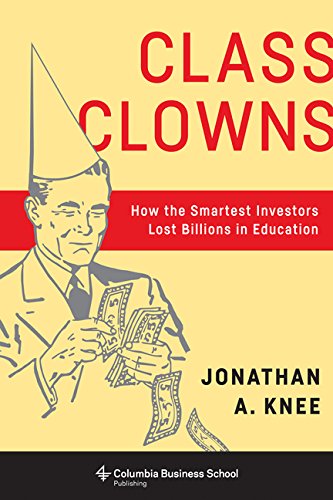
Class clowns : how the smartest investors lost billions in education / Jonathan A. Knee.
Material type: TextSeries: Columbia Business School publishingPublisher: New York : Columbia University Press, [2017]Description: 1 online resourceContent type:
 - text
- computer
- online resource
- 9780231543330
- 0231543336
- 338.4/337 23
- LC65 .K59 2017
| Item type | Current library | Collection | Call number | Status | Date due | Barcode | Item holds | |
|---|---|---|---|---|---|---|---|---|
 eBook
eBook
|
e-Library | EBSCO Business | Available |
Includes bibliographical references and index.
Introduction -- The wizard of ed -- Rupert and the chancellor: a tragic love story -- Curious George schools John Paulson -- Michael Milken: master of the knowledge universe -- What makes a good education business? -- Lessons from clown school.
Print version record.
The past thirty years have seen dozens of otherwise successful investors try to improve education through the application of market principles. They have funneled billions of dollars into alternative schools, online education, and textbook publishing, and they have, with surprising regularity, lost their shirts. In Class Clowns, professor and investment banker Jonathan A. Knee dissects what drives investors' efforts to improve education and why they consistently fail. Knee takes readers inside four spectacular financial failures in education: Rupert Murdoch's billion-dollar effort to reshape elementary education through technology; the unhappy investors--including hedge fund titan John Paulson--who lost billions in textbook publisher Houghton Mifflin; the abandonment of Knowledge Universe, Michael Milken's twenty-year mission to revolutionize the global education industry; and a look at Chris Whittle, founder of EdisonLearning and a pioneer of large-scale transformational educational ventures, who continues to attract investment despite decades of financial and operational disappointment. Although deep belief in the curative powers of the market drove these initiatives, it was the investors' failure to appreciate market structure that doomed them. Knee asks: What makes a good education business? By contrasting rare successes, he finds a dozen broad lessons at the heart of these cautionary case studies. Class Clowns offers an important guide for public policy makers and guardrails for future investors, as well as an intelligent exposé for activists and teachers frustrated with the repeated underperformance of these attempts to shake up education.
In English.
Master record variable field(s) change: 050