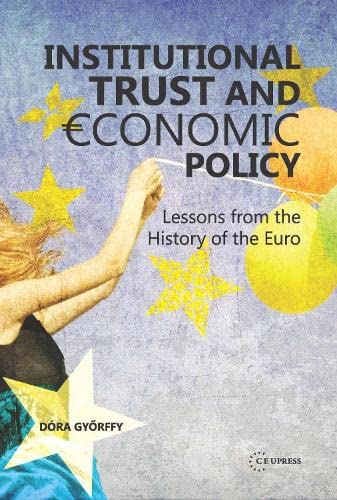
Institutional trust and economic policy : lessons from the history of the euro / Dóra Győrffy.
Material type: TextPublisher: Budapest ; New York : Central European University Press, 2013Copyright date: ©2013Description: 1 online resource (xv, 222 pages) : ‡b illustrationsContent type:
 - text
- computer
- online resource
- 9786155225345
- 6155225346
- Trust
- Euro
- European Union countries -- Economic policy
- Confidence
- European Economic Community countries -- Economic policy
- Confiance
- Euro (Monnaie)
- Pays de l'Union européenne -- Politique économique
- BUSINESS & ECONOMICS -- Economics -- Microeconomics
- POLITICAL SCIENCE -- Political Economy
- UE/CE Euro
- UE/CE UEM = Union économique et monétaire
- Politique économique
- Crise économique
- Macroéconomie
- UE/CE Etats membres
- Confidence
- Economic policy
- Euro
- Trust
- European Union countries
- 21st century, Economic policy, Euro, European Union, Political economy, Political studies, Trust
- 338.501/9 23
- BF575.T7 G96 2013eb
| Item type | Current library | Collection | Call number | Status | Date due | Barcode | Item holds | |
|---|---|---|---|---|---|---|---|---|
 eBook
eBook
|
e-Library | EBSCO Business | Available |
Includes bibliographical references (pages [199]-216) and index.
Print version record.
Introduction -- Institutional Trust and Individual Decision Making -- Institutional Trust and Policymaking in the EMU -- Fiscal Developments in the EU-15, 1992-2007 -- The Maastricht Process in the CEE-10 -- Financial Crisis in the EU-25 -- The Relevance of Trust for Economic Outcomes.
This book seeks to link theoretical debates on the relevance of trust in economic outcomes with arguments about the origins and lessons of the subprime crisis. By what mechanisms does trust influence economic outcomes? Under what conditions do these mechanisms prevail? How do debates about trust help our understanding of the subprime crisis in the European Union? By integrating insights from Post-Keynesian, Austrian and new institutional economics, the central proposition of the analysis is that the presence or absence of institutional trust creates virtuous and vicious cycles in law-abiding, which critically influence the possibility for economic agents to have realistic long-term plans.
English.
Added to collection customer.56279.3