Innovation through collaboration / edited by Michael M. Beyerlein, Susan T. Beyerlein, Frances A. Kennedy.
Material type: TextSeries: Advances in interdisciplinary studies of work teams ; v. 12.Publication details: Amsterdam ; Oxford : Elsevier JAI, 2006.Description: 1 online resource (xviii 274 pages) : illustrationsContent type:
 - text
- computer
- online resource
- 9780080463711
- 0080463711
- 0080463495
- 9780080463490
- 9781849504300
- 184950430X
- 658.4/022 22
- HD66 .A36eb vol. 12
| Item type | Current library | Collection | Call number | Status | Date due | Barcode | Item holds | |
|---|---|---|---|---|---|---|---|---|
 eBook
eBook
|
e-Library | EBSCO Business | Available |
Includes bibliographical references.
Cover -- Contents -- List of contributors -- Acknowledgments -- About the editors -- Introduction -- References -- Chapter 1. Collaboration in Cross-Functional Product Innovation Teams -- Introduction -- Integration and Collaboration -- Conclusions -- References -- Appendix -- Chapter 2. Leading Innovation through Collaboration -- Organizational Innovation -- Creativity -- Leading Innovation -- Leading Change -- A Special Case of Change -- Conclusion -- References -- Chapter 3. Communities of Practice: A Critical Perspective on Collaboration -- Introduction -- Communities of Practice -- Modernism and Postmodernism -- Principles of Organization -- Collaboration and Learning -- Collaboration and Innovation -- Conclusion -- Notes -- Acknowledgments -- References -- Chapter 4. Team Innovation through Collaboration -- Creativity, Implementation of Innovation, and Collaboration -- A Model of Team Innovation -- Promoting Collaboration between Teams: The Intergroup Relations Theories -- Collaboration for Innovation -- Recommendations for Practice -- Conclusion -- Acknowledgements -- References -- Chapter 5. Innovation: Achieving Balance among Empowerment, Accountability and Control -- Introduction -- Role of information -- Collaborative Innovation Framework -- Management Control Systems -- Rebalancing Control Mechanisms -- Conclusion -- References -- Chapter 6. Innovation and Technology Transfer Intermediaries: A Systemic International Study -- Introduction -- The Context of Technology Transfer and IP Intermediaries -- TTIs and the Role of Networks -- The Roles of TTI Organisations -- Comparing the ITT Patterns of Technology Transfer Relationships -- Some Approaches to Innovation and the Operation of TTIS -- Discussion -- Concluding Remarks -- Suggestions for Further Research -- References -- Chapter 7. Collaboration, Proximity, and Innovation -- Introduction -- Theories of Collaboration and Proximity -- The Innovation Survey -- Discussion -- Conclusions -- References -- Appendix. Percentage of Business Units Involved in Co-operative and Collaborative Arrangements and Location of Collaborators During the Period 2001-2003 (by Province) -- Chapter 8. Social Networking and the Development of New Ventures -- Introduction -- Social Networks and Innovation -- Networks and Resources -- Alpha Clean -- TransportSafe -- Discussion -- Individual or Social Ownership of the Innovation Process -- Focus on Risk or Opportunities -- Network Embeddedness and Bootstrapping -- Conclusions -- Acknowledgments -- References -- Chapter 9. Creation of a Collaborative Environment for Innovation: The Effect of a Simulation Tool's Development and Use -- Introduction -- Research Methodology -- Empirical Findings -- Summarizing -- Conclusions -- References -- Chapter 10. Building Collaborative Capacity: An Innovative Strategy for Homeland Security Preparedness -- Collaborativ.
Print version record.
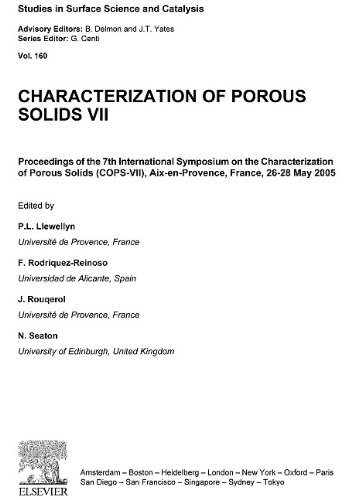
The 7th International Symposium on the Characterization of Porous Solids (COPS-VII) was held in the Congress Centre in Aix-en-Provence between the 25th-28th May 2005. The symposium covered recent results of fundamental and applied research on the characterization of porous solids. Papers relating to characterization methods such as gas adsorption and liquid porosimetry, X-ray techniques and microscopic measurements as well as the corresponding molecular modelling methods were given. These characterization methods were shown to be applied to all types of porous solids such as clays, carbons, or.