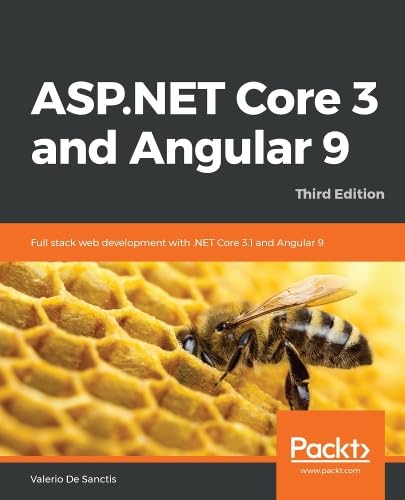
ASP.NET Core 3 and Angular 9 : full-stack web development with .NET Core 3.1 and Angular 9 / Valerio De Sanctis.
Material type: TextPublisher: Birmingham : Packt Publishing, 2020Edition: Third editionDescription: 1 online resourceContent type:
 - text
- computer
- online resource
- 9781789611489
- 1789611482
- 005.276 23
- TK5105.8885.A26
| Item type | Current library | Collection | Call number | Status | Date due | Barcode | Item holds | |
|---|---|---|---|---|---|---|---|---|
 eBook
eBook
|
e-Library | EBSCO Computers | Available |
Includes bibliographical references.
Cover -- Title Page -- Copyright and Credits -- About Packt -- Contributors -- Table of Contents -- Preface -- Chapter 1: Getting Ready -- Technical requirements -- Two players, one goal -- The ASP.NET Core revolution -- ASP.NET Core 1.x -- ASP.NET Core 2.x -- ASP.NET Core 3.x -- What's new in Angular? -- GetAngular -- AngularJS -- Angular 2 -- Angular 4 -- Angular 5 -- Angular 6 -- Angular 7 -- Angular 8 -- Angular 9 -- Reasons for choosing .NET Core and Angular -- A full-stack approach -- SPAs, NWAs, and PWAs -- Single-page application -- Native web application
Progressive web application -- Product owner expectations -- A sample SPA project -- Not your usual Hello World! -- Preparing the workspace -- Disclaimer -- do (not) try this at home -- The broken code myth -- Stay hungry, stay foolish, yet be responsible as well -- Setting up the project -- Installing the .NET Core SDK -- Checking the SDK version -- Creating the .NET Core and Angular project -- Opening the new project in Visual Studio -- Performing a test run -- Summary -- Suggested topics -- References -- Chapter 2: Looking Around -- Technical requirements -- Solution overview
The .NET Core back-end -- Razor Pages -- Controllers -- Configuration files -- Program.cs -- Web host versus web server -- Startup.cs -- appsettings.json -- The Angular front-end -- Workspace -- angular.json -- package.json -- Upgrading (or downgrading) Angular -- Upgrading (or downgrading) the other packages -- tsconfig.json -- Other workspace-level files -- The /ClientApp/src/ folder -- The /app/ folder -- AppModule -- Server-side AppModule for SSR -- AppComponent -- Other components -- Testing the app -- HomeComponent -- NavMenuComponent -- CounterComponent -- The specs.ts file(s)
Our first app test -- Getting to work -- Static file caching -- A blast from the past -- Back to the future -- Testing it out -- The strongly-typed approach(es) -- Client app cleanup -- Trimming down the Component list -- The AppModule source code -- Updating the NavMenu -- Summary -- Suggested topics -- References -- Chapter 3: Front-end and Back-end Interactions -- Technical requirements -- Introducing .NET Core health checks -- Adding the HealthChecks middleware -- Adding an Internet Control Message Protocol (ICMP) check -- Possible outcomes -- Creating an ICMPHealthCheck class
Adding the ICMPHealthCheck to the pipeline -- Improving the ICMPHealthCheck class -- Adding parameters and response messages -- Updating the middleware setup -- Implementing a custom output message -- About health check responses and HTTP status codes -- Configuring the output message -- Health checks in Angular -- Creating the Angular Component -- health-check.component.ts -- Imports and modules -- DI -- ngOnInit (and other lifecycle hooks) -- Constructor -- HttpClient -- Observables -- Interfaces -- health-check.component.html -- health-check.component.css
This full-stack guide will help you become fluent in both frontend and backend web development by combining the impressive capabilities of ASP.NET Core 3.1 and Angular 9 from project setup right through the deployment. Furthermore, you will learn to add capabilities like security, testability, and scalability to your apps using expert techniques.
Master record variable field(s) change: 082 - OCLC control number change