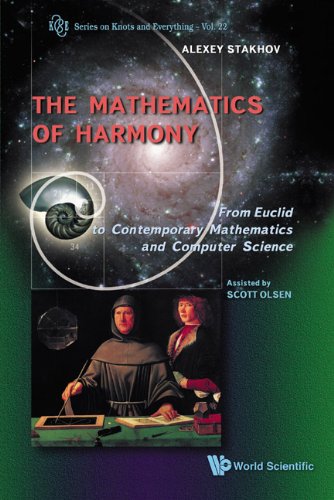
The mathematics of harmony : from Euclid to contemporary mathematics and computer science / Alexey Stakhov ; assisted by Scott Olsen.
Material type: TextSeries: K & E series on knots and everything ; v. 22.Publication details: Singapore ; Hackensack, NJ : World Scientific, ©2009.Description: 1 online resource (xlix, 694 pages) : illustrations (some color)Content type:
 - text
- computer
- online resource
- 9789812775832
- 9812775838
- Fibonacci numbers
- Golden section
- Mathematics -- History
- Computer science
- Electronic Data Processing
- Suites de Fibonacci
- Nombre d'or
- Mathématiques -- Histoire
- Informatique
- Fibonacci numbers
- golden section
- MATHEMATICS -- Number Theory
- Computer science
- Fibonacci numbers
- Golden section
- Mathematics
- Goldener Schnitt
- Fibonacci-Folge
- mathematik
- Ästhetik -- Mathematik
- Mathematik -- Ästhetik
- 512.7/2 22
- QA246.5 .S73 2009eb
| Item type | Current library | Collection | Call number | Status | Date due | Barcode | Item holds | |
|---|---|---|---|---|---|---|---|---|
 eBook
eBook
|
e-Library | EBSCO Mathematics | Available |
Includes bibliographical references and index.
Three "key" problems of mathematics on the stage of its origin -- Classical golden mean, Fibonacci numbers, and platonic solids -- The golden section -- Fibonacci and Lucas numbers -- Regular polyhedrons -- Mathematics of harmony -- Generalizations of Fibonacci numbers and the golden mean -- Hyperbolic Fibonacci and Lucas functions -- Fibonacci and golden matrices -- Application in computer science -- Algorithmic measurement theory -- Fibonacci computers -- Codes of the golden proportion -- Ternary mirror-symmetrical arithmetic -- A new coding theory based on a matrix approach -- Dirac's principle of mathematical beauty and the mathematics of harmony : clarifying the origins and development of mathematics -- Appendix : Museum of harmony and the golden section.
This volume is a result of the author's four decades of research in the field of Fibonacci numbers and the Golden Section and their applications. It provides a broad introduction to the fascinating and beautiful subject of the "Mathematics of Harmony," a new interdisciplinary direction of modern science. This direction has its origins in "The Elements" of Euclid and has many unexpected applications in contemporary mathematics (a new approach to a history of mathematics, the generalized Fibonacci numbers and the generalized golden proportions, the "golden" algebraic equations, the generalized Binet formulas, Fibonacci and "golden" matrices), theoretical physics (new hyperbolic models of Nature) and computer science (algorithmic measurement theory, number systems with irrational radices, Fibonacci computers, ternary mirror-symmetrical arithmetic, a new theory of coding and cryptography based on the Fibonacci and "golden" matrices). The book is intended for a wide audience including mathematics teachers of high schools, students of colleges and universities and scientists in the field of mathematics, theoretical physics and computer science. The book may be used as an advanced textbook by graduate students and even ambitious undergraduates in mathematics and computer science
Print version record.
Added to collection customer.56279.3