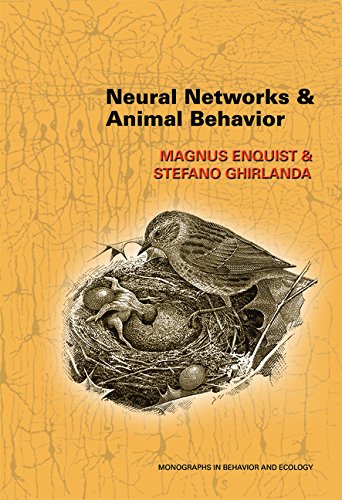
Neural networks and animal behavior / Magnus Enquist, Stefano Ghirlanda.
Material type: TextSeries: Monographs in behavior and ecologyPublisher: Princeton : Princeton University Press, [2005]Copyright date: ©2005Description: 1 online resource (ix, 253 pages) : illustrationsContent type:
 - text
- computer
- online resource
- 9781400850785
- 1400850789
- Animal behavior -- Computer simulation
- Neural networks (Computer science)
- Animal behavior
- Behavior, Animal
- Neural Networks, Computer
- Animaux -- Mœurs et comportement -- Simulation par ordinateur
- Réseaux neuronaux (Informatique)
- Animaux -- Mœurs et comportement
- SCIENCE -- Life Sciences -- Zoology -- General
- COMPUTERS -- Neural Networks
- Animal behavior -- Computer simulation
- Neural networks (Computer science)
- Computersimulation
- Neuronales Netz
- Verhalten
- Tiere
- 591.5 22
- QL751.65.D37 E57 2005eb
- WT 3700
- BIO 781f
- BIO 790f
- BIO 110f
| Item type | Current library | Collection | Call number | Status | Date due | Barcode | Item holds | |
|---|---|---|---|---|---|---|---|---|
 eBook
eBook
|
e-Library | EBSCO Science | Available |
Includes bibliographical references (pages 219-248) and index.
Ch. 1. Understanding animal behavior -- Ch. 2. Fundamentals of neural network models -- Ch. 3. Mechanisms of behavior -- Ch. 4. Learning and ontogeny -- Ch. 5. Evolution -- Ch. 6. Conclusions.
Print version record.
How can we make better sense of animal behavior by using what we know about the brain? This is the first book that attempts to answer this important question by applying neural network theory. Scientists create Artificial Neural Networks (ANNs) to make models of the brain. These networks mimic the architecture of a nervous system by connecting elementary neuron-like units into networks in which they stimulate or inhibit each other's activity in much the same way neurons do. This book shows how scientists can employ ANNs to analyze animal behavior, explore the general principles of the nervous systems, and test potential generalizations among species. The authors focus on simple neural networks to show how ANNs can be investigated by math and by computers. They demonstrate intuitive concepts that make the operation of neural networks more accessible to nonspecialists. The first chapter introduces various approaches to animal behavior and provides an informal introduction to neural networks, their history, and their potential advantages. The second chapter reviews artificial neural networks, including biological foundations, techniques, and applications. The following three chapters apply neural networks to such topics as learning and development, classical instrumental condition, and the role of genes in building brain networks. The book concludes by comparing neural networks to other approaches. It will appeal to students of animal behavior in many disciplines. It will also interest neurobiologists, cognitive scientists, and those from other fields who wish to learn more about animal behavior.
In English.
WorldCat record variable field(s) change: 650