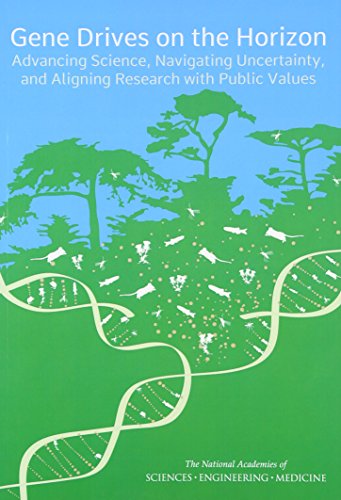
Gene drives on the horizon : advancing science, navigating uncertainty, and aligning research with public values / Committee on Gene Drive Research in Non-Human Organisms: Recommendations for Responsible Conduct, Board on Life Sciences, Division on Earth and Life Studies, the National Academies of Sciences, Engineering, Medicine.
Material type: TextPublisher: Washington, DC : The National Academies Press, [2016]Description: 1 online resource (1 PDF file (xii, 217 pages)) : illustrations, portraitsContent type:
 - text
- computer
- online resource
- 9780309437875
- 0309437873
- 9780309437882
- 0309437881
- Genetic engineering -- Moral and ethical aspects -- Congresses
- Genetic engineering -- Health aspects -- Congresses
- Transgenic organisms -- Risk assessment -- Congresses
- Transgenic organisms -- Moral and ethical aspects -- Congresses
- Environmental health
- Transgenic organisms
- Genetic engineering
- Risk assessment
- Organisms, Genetically Modified
- Containment of Biohazards
- Ethics, Research
- Genetic Engineering
- Risk Assessment
- Organismes génétiquement modifiés -- Évaluation du risque -- Congrès
- Organismes génétiquement modifiés -- Aspect moral -- Congrès
- Organismes génétiquement modifiés
- Génie génétique
- Évaluation du risque
- risk assessment
- TECHNOLOGY & ENGINEERING -- Agriculture -- Animal Husbandry
- Environmental health
- Genetic engineering -- Moral and ethical aspects
- Transgenic organisms -- Risk assessment
- 636.0821 23
- QH442.6
- 2016 H-675
- QH 442.6
| Item type | Current library | Collection | Call number | Status | Date due | Barcode | Item holds | |
|---|---|---|---|---|---|---|---|---|
 eBook
eBook
|
e-Library | EBSCO Science | Available |
Includes bibliographical references.
The state of knowledge of the molecular biology, population genertic, and ecology of gene-drive modified organisms -- Case studies to examine questions about gene-drive modified organisms -- Charting human values -- Phased testing and scientific approaches to reducing potention harms of gene drives -- Assessing risks of gene-drive modified organisms -- Engaging communities, stakeholders, and publics -- Governing gene drive research and applications -- Gene drives on the horizon : overarching considerations -- Glossary -- Acronyms -- Appendix A. Agenda for the Workshop on the Science, Ethics and Governance Considerations for Gene Drive Research -- Appendix B. List of gene drive webinars -- Apppendix C. Mosquito control strategies -- Appendix D. Rodent control strategies -- Appendix E.A brief history of ecological risk assessment -- Appendix F. Biographical sketches of Committee members.
Research on gene drive systems is rapidly advancing. Many proposed applications of gene drive research aim to solve environmental and public health challenges, including the reduction of poverty and the burden of vector-borne diseases, such as malaria and dengue, which disproportionately impact low and middle income countries. However, due to their intrinsic qualities of rapid spread and irreversibility, gene drive systems raise many questions with respect to their safety relative to public and environmental health. Because gene drive systems are designed to alter the environments we share in ways that will be hard to anticipate and impossible to completely roll back, questions about the ethics surrounding use of this research are complex and will require very careful exploration. Gene Drives on the Horizon outlines the state of knowledge relative to the science, ethics, public engagement, and risk assessment as they pertain to research directions of gene drive systems and governance of the research process. This report offers principles for responsible practices of gene drive research and related applications for use by investigators, their institutions, the research funders, and regulators.
This activity was supported by Contract No. 040815 with the Foundation for the National Institutes of Health, Contract No. 10002551/10002584 with the US Department of Health and Human Services/National Institutes of Health. The activities received additional support from the National Academy of Sciences Biology and Biotechnology Fund. Any opinions, findings, conclusions, or recommendations expressed in this publication do not necessarily reflect the views of any organization or agency that provided support for the project.
Online resource; title from PDF title page (viewed Oct. 13, 2016).
WorldCat record variable field(s) change: 650