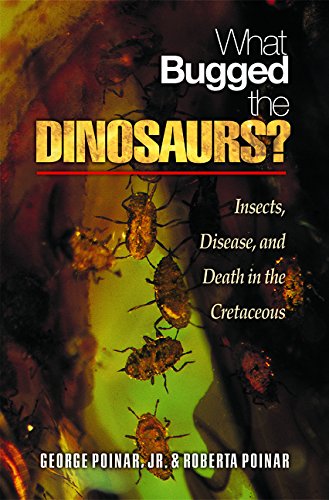
What bugged the dinosaurs? [electronic resource] : insects, disease, and death in the Cretaceous / George Poinar, Jr. and Roberta Poinar ; with photographs and drawings by the authors.
Material type: TextPublication details: Princeton, N.J. : Princeton University Press, c2008.Description: 1 online resource (x, 264 p., 16 p. of plates) : ill. (some col.), mapsISBN:
 - 9781400835690 (electronic bk.)
- 1400835690 (electronic bk.)
- Insects, disease, and death in the Cretaceous
- 560/.45 22
- QE720 .P65 2008eb
| Item type | Current library | Collection | Call number | Status | Date due | Barcode | Item holds | |
|---|---|---|---|---|---|---|---|---|
 eBook
eBook
|
e-Library | EBSCO Science | Available |
Includes bibliographical references (p. [225]-252) and index.
This book reveals that T. rex was not the only killer in the Cretaceous: insects--from biting sand flies to disease-causing parasites--dominated life on the planet and played a significant role in the life and death of the dinosaurs. Analyzing exotic insects fossilized in Cretaceous amber at three major deposits in Lebanon, Burma, and Canada, the authors reconstruct the complex ecology of a hostile prehistoric world inhabited by voracious swarms of insects. They draw upon tantalizing new evidence from their discoveries of disease-producing vertebrate pathogens in Cretaceous blood-sucking flies, as well as intestinal worms and protozoa found in fossilized dinosaur excrement, to provide a unique view of how insects infected with malaria, leishmania, and other pathogens, together with intestinal parasites, could have devastated dinosaur populations.--From publisher description.
Preface -- Acknowledgments -- Introduction -- 1. Fossils : a time capsule -- 2. The Cretaceous : a time of change -- 3. Herbivory -- 4. Dinosaurs competing with insects -- 5. Did dinosaurs or insects "invent" flowering plants? -- 6. Pollination -- 7. Blights and diseases of Cretaceous plants -- 8. The Cretaceous Age of chimeras and other oddities -- 9. Sanitary engineers of the Cretaceous -- 10. The case for entomophagy among dinosaurs -- 11. Gorging on dinosaurs -- 12. Biting midges -- 13. Sand flies -- 14. Mosquitoes -- 15. Blackflies -- 16. Horseflies and deerflies -- 17. Fleas and lice -- 18. Ticks and mites -- 19. Parasitic worms -- 20. The discovery of Cretaceous diseases -- 21. Diseases and the evolution of pathogens -- 22. Insects : the ultimate survivors -- 23. Extinctions and the K/T boundary -- Appendix A : Cretaceous Hexapoda -- Appendix B : Key factors contributing to the survival of terrestrial animals -- Appendix C : Problems with evaluating the fossil record and extinctions -- References -- Index.
Description based on print version record.