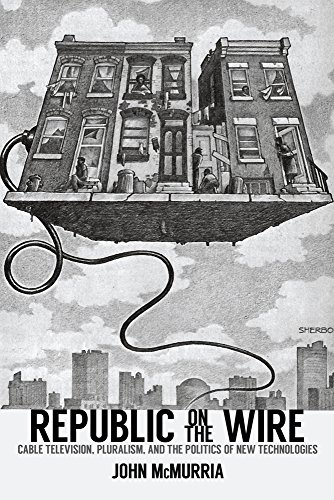
Republic on the wire : cable television, pluralism, and the politics of new technologies, 1948-1984 / John McMurria.
Material type: TextPublisher: New Brunswick, New Jersey : Rutgers University Press, [2017]Description: 1 online resource (xii, 250 pages)Content type:
 - text
- computer
- online resource
- 9780813585321
- 0813585325
- Cable television -- United States -- History
- Broadcasting -- United States -- History
- Television broadcasting -- United States -- History
- SOCIAL SCIENCE -- Media Studies
- TECHNOLOGY & ENGINEERING -- Telecommunications
- HISTORY -- United States -- 20th Century
- Broadcasting
- Cable television
- Television broadcasting
- United States
- BUSINESS & ECONOMICS / Industries / Media & Communications
- TECHNOLOGY & ENGINEERING / Telecommunications
- SOCIAL SCIENCE / Media Studies
- 384.55/50973 23
- HE8700.72.U6 M46 2017eb
- SOC052000 | TEC041000 | HIS036060
| Item type | Current library | Collection | Call number | Status | Date due | Barcode | Item holds | |
|---|---|---|---|---|---|---|---|---|
 eBook
eBook
|
e-Library | EBSCO Social Science | Available |
"The history of cable television in America is far older than networks like MTV, ESPN, and HBO, which are so familiar to us today. Tracing the origins of cable TV back to the late 1940s, media scholar John McMurria also locates the roots of many current debates about premium television, cultural elitism, minority programming, content restriction, and corporate ownership. Republic on the Wire takes us back to the pivotal years in which media regulators and members of the viewing public presciently weighed the potential benefits and risks of a two-tiered television system, split between free broadcasts and pay cable service. Digging into rare archives, McMurria reconstructs the arguments of policymakers, whose often sincere advocacy for the public benefits of cable television were fueled by cultural elitism and the priority to maintain order during a period of urban Black rebellions. He also tells the story of the people of color, rural residents, women's groups, veterans, seniors, and low-income viewers who challenged this reasoning and demanded an equal say over the future of television. By excavating this early cable history, and placing equality at the center of our understanding of media democracy, Republic on the Wire is a real eye-opener as it develops a new methodology for studying media policy in the past and present"-- Provided by publisher.
Includes bibliographical references and index.
Print version record.
Title; Copyright; Dedication; Contents; Acknowledgments; Introduction. American Pluralism, Television Policy, and the Method of Equality; 1. Broadcast Policy, Television Spectrum, and the Pluralist Logics of Inequality; 2. Contesting (In)Equality at the Margins of Television Reception; 3. Pay-TV Orders; 4. Local Origination, Public Access, and the Hierarchical Logics of Civic Culture; 5. Blue Skies, Black Cultures; Epilogue. Neutrality, Connectivity, or Equality When Media Converge; Notes; Select Bibliography; Index; About the Author
Master record variable field(s) change: 072