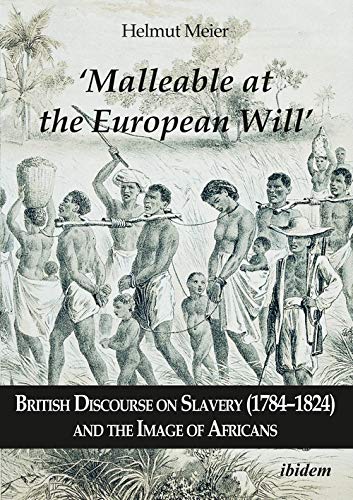
'Malleable at the European Will' : British Discourse on Slavery (1784-1824) and the Image of Africans / Helmut Meier.
Material type: TextPublisher: Stuttgart : Ibidem Press, [2019]Description: 1 online resourceContent type:
 - text
- computer
- online resource
- 9783838272733
- 3838272730
- 306.362 23
- HT1025
| Item type | Current library | Collection | Call number | Status | Date due | Barcode | Item holds | |
|---|---|---|---|---|---|---|---|---|
 eBook
eBook
|
e-Library | EBSCO Social Science | Available |
Includes bibliographical references.
Online resource; title from PDF title page (EBSCO, viewed March 28, 2019).
Intro; Table of Contents; 1 Introduction; 2 Methodology; 2.1 CDA; 2.2 Post-Colonial Reading and Concepts; 2.3 Post-humanism and Agamben; 2.4 Race; 2.5 QDA Software; 2.5.1 Codes; 2.5.2 Memos; 2.5.3 Retrieval; 2.6 Corpus Linguistics; 3 Historical Context, Key Events and Discursive Events; 3.1 Introduction; 3.2 The "Original State of Mankind"; 3.3 Biblical Events; 3.4 Greco-Roman Antiquity; 3.4.1 Authority of the Ancients; 3.4.2 Slaves in Antiquity; 3.4.2.1 Greek Slaves; 3.4.2.2 Roman Slaves; 3.4.3 Decline and Fall of the Roman Empire; 3.5 Middle Ages and Feudalism; 3.6 Orient versus Occident
3.6.1 Islam as the Ultimate Other3.6.2 Arabic Slave Trade; 3.6.3 Islamic Influence in Africa as "Some Feeble Light"; 3.7 Modernity and the Atlantic System; 3.7.1 African History; 3.7.2 Slave Trade and Abolition; 3.7.3 British History; 3.7.4 The American Revolution; 3.7.5 History of the Caribbean Islands; 3.7.6 Larger Historical Context-British and European History; 3.8 Conclusion; 4 The Discourse on Slavery; 4.1 Corpus-based Appreciation of the Discourse as a Whole; 4.1.1 The Ten Most Frequent Nouns; 4.1.2 Thematic Selection from the 150 Most Frequent Nouns; 4.2 James Ramsay's Essay (1784)
4.2.1 James Ramsay-Biography and self-representation in the text4.2.2 Synopsis and Argumentative Aims of the Essay; 4.2.3 Ideology; 4.3 Anonymous: An Answer to James Ramsay's Essay (1784); 4.3.1 "Some Gentlemen of St. Christopher"; 4.3.2 Synopsis and Arguments; 4.3.3 Ideology; 4.4 James Tobin's Cursory Remarks (1785); 4.4.1 James Tobin-Biography and Self-representation in the Text; 4.4.2 Synopsis and Argumentative Aim; 4.4.3 Ideology; 4.5 Thomas Clarkson's Essay (1786/88); 4.5.1 Thomas Clarkson-Biography and Self-representation in his Texts; 4.5.2 Synopsis and Argumentative Aim
4.5.3 Ideology4.6 Gilbert Francklyn's Letters (1789); 4.6.1 Gilbert Francklyn; 4.6.2 Synopsis and Argumentative Aims; 4.6.3 Ideology; 4.7 Anonymous: Observations (1790); 4.7.1 The Anonymous Author; 4.7.2 Synopsis and Argument of Observations; 4.7.3 Ideology; 4.8 Clarkson's Letters (1790); 4.8.1 Synopsis and Argument of the Letters; 4.8.2 Ideology; 4.9 Anonymous: Fugitive Thoughts (1792); 4.9.1 The Anonymous Author; 4.9.2 Synopsis and Argument; 4.9.3 Ideology; 4.10 "Mercator": Letters (1807); 4.10.1 Biographical Note; 4.10.2 Synopsis and Argument of the Letters; 4.10.3 Ideology
4.11 Wilberforce: Letter (1807)4.11.1 William Wilberforce; 4.11.2 Synopsis and Argument of the Letter; 4.11.3 Ideology; 4.12 Wilberforce: Appeal (1823); 4.12.1 Synopsis and Argument of Appeal; 4.12.2 Ideology; 4.13 Bridges: Voice (1823); 4.13.1 George Wilson Bridges; 4.13.2 Synopsis and Argument; 4.13.3 Ideology; 4.14 Clarkson: Thoughts (1823); 4.14.1 Argument and Synopsis of Thoughts; 4.14.2 Ideology; 4.15 Hampden: Commentary on Clarkson (1824); 4.15.1 Biographical Note; 4.15.2 Synopsis and Argument; 4.15.3 Ideology; 4.16 Heyrick: Immediate Abolition (1824); 4.16.1 Elizabeth Heyrick
Helmut Meier's study of pro- and anti-slavery texts from 1784'1825 focuses on understanding the distinct image of Africans in the British debate on the slave trade and slavery as such. Starting from the premise that, at the threshold from the early to the late modern period, the distinct image of Africans as slaves was instrumental in universalizing a Eurocentric concept of capitalist wage labor both at the colonial centres and margins, Meier argues that, by portraying African slaves as suffering wretches, especially anti-slavery texts created colonial Others in an indistinct zone between inclusion and exclusion from humanity. The discourse on slavery thus constructs African slaves as mimetic Others which could subsequently become the objects of a discourse of colonial reform and 'betterment.'
Added to collection customer.56279.3