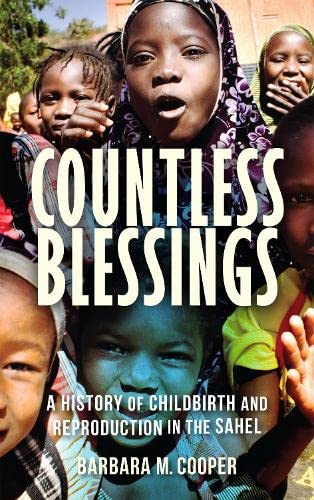
Countless blessings : a history of childbirth and reproduction in the Sahel / Barbara M. Cooper.
Material type: TextPublisher: Bloomington, Indiana : Indiana University Press, 2019Description: 1 online resourceContent type:
 - text
- computer
- online resource
- 9780253042033
- 0253042038
- Childbirth -- Niger
- Childbirth -- Sahel
- Childbirth -- Social aspects -- Niger
- Childbirth -- Social aspects -- Sahel
- Fertility, Human -- Niger
- Fertility, Human -- Sahel
- Birth customs -- Niger
- Birth customs -- Sahel
- Reproductive health -- Niger
- Reproductive health -- Sahel
- Women, Hausa -- Social conditions
- Hausa (African people) -- Social life and customs
- SOCIAL SCIENCE / Sociology / Marriage & Family
- HEALTH & FITNESS / Pregnancy & Childbirth
- 392.1/20966 23
- GT2465.S15
| Item type | Current library | Collection | Call number | Status | Date due | Barcode | Item holds | |
|---|---|---|---|---|---|---|---|---|
 eBook
eBook
|
e-Library | EBSCO Social Science | Available |
Includes bibliographical references and index.
Introduction -- Environment, seduction, and fertility -- Tensions in the wake of conquest : gender and reproduction after abolition -- Personhood, socialization, and shame -- Colonial accounting -- Perils of pregnancy and childbirth -- Producing healthy babies and healthy laborers -- Feminists, Islamists, and demographers -- Let's talk about bastards -- Contemporary sexuality and childbirth -- Conclusion: Traveling companions and entrustments in contemporary Niger.
How do women in Hausa-speaking Niger think about pregnancy and childbirth differently from women in the United States or Europe? Barbara M. Cooper sets out to answer this question to understand how childbirth has been experienced in the history of the African Sahel, a place that has the world's highest fertility rates, but also one of the highest rates of maternal and infant mortality. Cooper presents a history of what it is like for many rural women to bear children in Niger. She sketches out the influence of geography, ethnicity, social status, and religion to come to a deeper understanding of reproduction and the practices of fertility and maternal well-being from colonialism to today. Cooper unveils a complex landscape of religious and family life where women who have no children may be shunned, where competition between wives for fertility may be intense, and where access to medicine may be improvised. In this patriarchal society where women are poorly educated a culture of sorrow and shame develops among them. Cooper suggests that in this volatile environment it is little wonder that pregnancy and birth are tremendously dangerous practices.
Print version record.
Master record variable field(s) change: 072