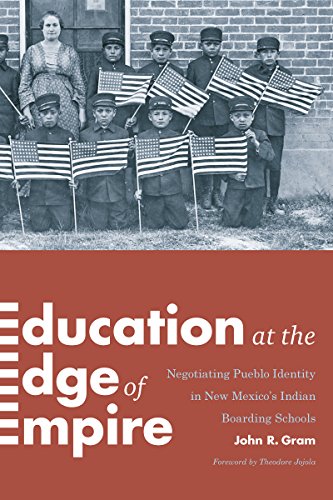
Education at the edge of empire : negotiating Pueblo identity in New Mexico's Indian boarding schools / John R. Gram ; foreword by Thodore Jojola.
Material type: TextSeries: Indigenous confluencesPublisher: Seattle : University of Washington Press, [2015]Description: 1 online resource (xviii, 242 pages)Content type:
 - text
- computer
- online resource
- 9780295806051
- 0295806052
- Negotiating Pueblo identity in New Mexico's Indian boarding schools
- Albuquerque Indian School -- History
- Santa Fe Indian School -- History
- Albuquerque Indian School
- Santa Fe Indian School
- Pueblo Indians -- Education -- History
- Off-reservation boarding schools -- New Mexico -- History
- Pueblo Indians -- Ethnic identity
- Pueblo Indians -- Cultural assimilation
- Community and school -- New Mexico -- History
- Indians of North America -- Education -- New Mexico -- History
- Indians of North America -- New Mexico -- Ethnic identity
- Pueblo -- Éducation -- Histoire
- Internats pour Autochtones -- Nouveau-Mexique -- Histoire
- Pueblo -- Identité ethnique
- Pueblo -- Acculturation
- Relations école-collectivité -- Nouveau-Mexique -- Histoire
- Peuples autochtones -- Nouveau-Mexique -- Identité ethnique
- HISTORY -- United States -- State & Local -- Southwest (AZ, NM, OK, TX)
- HISTORY -- United States -- State & Local -- West (AK, CA, CO, HI, ID, MT, NV, UT, WY)
- EDUCATION / History
- Community and school
- Indians of North America -- Education
- Indians of North America -- Ethnic identity
- Off-reservation boarding schools
- Pueblo Indians -- Cultural assimilation
- Pueblo Indians -- Education
- Pueblo Indians -- Ethnic identity
- New Mexico
- 978.9004/974 23
- E99.P9
| Item type | Current library | Collection | Call number | Status | Date due | Barcode | Item holds | |
|---|---|---|---|---|---|---|---|---|
 eBook
eBook
|
e-Library | EBSCO Social Science | Available |
Includes bibliographical references (pages 231-238) and index.
Introduction: Eastern reforms encounter southwestern communities -- The economics of education: the true cost of keeping the doors open -- The consequences of competition: the fight to control the flow of Pueblo students -- Geographies of imagination: competing understandings of people and place in the Southwest -- Everyday encounters: daily life at the Albuquerque and Santa Fe Indian schools -- The integration of worlds: what students and their communities made of the boarding school experience -- Conclusion: the successful legacy of assimilation's failure -- Appendix.
Description based on print version record and CIP data provided by publisher; resource not viewed.
"For the vast majority of Native American students in federal Indian boarding schools at the turn of the twentieth century, the experience was nothing short of tragic. Dislocated from family and community, they were forced into an educational system that sought to erase their Indian identity as a means of acculturating them to white society. However, as historian John Gram reveals, some Indian communities on the edge of the American frontier had a much different experience even influencing the type of education their children received. Shining a spotlight on Pueblo Indians' interactions with school officials at the Albuquerque and Santa Fe Indian Schools, Gram examines two rare cases of off-reservation schools that were situated near the communities whose children they sought to assimilate. Far from the federal government's reach and in competition with nearby Catholic schools for students, these Indian boarding school officials were in no position to make demands and instead were forced to pick their cultural battles with nearby Pueblo parents, who visited the schools regularly. As a result, Pueblo Indians were able to exercise their agency, influencing everything from classroom curriculum to school functions. As Gram reveals, they often mitigated the schools' assimilation efforts and assured the various pueblos' cultural, social, and economic survival. Greatly expanding our understanding of the Indian boarding school experience, Education at the Edge of Empire is grounded in previously overlooked archival material and student oral histories. The result is a groundbreaking examination that contributes to Native American, Western, and education histories, as well as to borderland and Southwest studies. It will appeal to anyone interested in knowing how some Native Americans were able to use the typically oppressive boarding school experience to their advantage."--Amazon.com.
Added to collection customer.56279.3