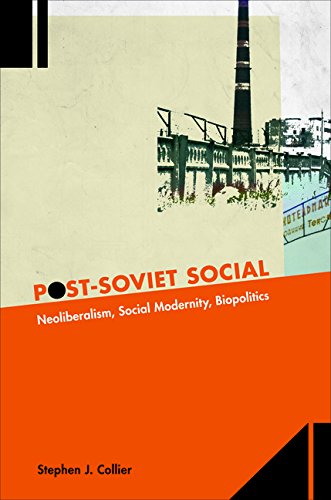
Post-Soviet social : neoliberalism, social modernity, biopolitics / Stephen J. Collier.
Material type: TextPublisher: Princeton ; Oxford : Princeton University Press, [2011]Copyright date: ©2011Description: 1 online resource (xiii, 304 pages) : illustrations, mapsContent type:
 - text
- computer
- online resource
- 9781400840427
- 1400840422
- 9786613101532
- 6613101532
- Russia (Federation) -- Economic policy -- 1991-
- Neoliberalism -- Russia (Federation)
- Biopolitics -- Russia (Federation)
- Post-communism -- Economic aspects -- Russia (Federation)
- Russie -- Politique économique -- 1991-
- Néo-libéralisme -- Russie
- Biopolitique -- Russie
- Postcommunisme -- Aspect économique -- Russie
- POLITICAL SCIENCE -- Economic Conditions
- BUSINESS & ECONOMICS -- Economics -- Comparative
- BUSINESS & ECONOMICS -- Economic Conditions
- BUSINESS & ECONOMICS -- Economic History
- HISTORY -- Europe -- Russia & the Former Soviet Union
- Biopolitics
- Economic policy
- Neoliberalism
- Post-communism -- Economic aspects
- Russia (Federation)
- Since 1991
- 330.947 22
- HC340.12 .C647 2011eb
| Item type | Current library | Collection | Call number | Status | Date due | Barcode | Item holds | |
|---|---|---|---|---|---|---|---|---|
 eBook
eBook
|
e-Library | EBSCO Social Science | Available |
Includes bibliographical references (pages 253-298) and index.
Introduction : post-Soviet, post-social? -- Soviet social modernity -- The birth of Soviet biopolitics -- City-building -- City-building in Belaya Kalitva -- Consolidation, stagnation, breakup -- Neoliberalism and social modernity -- Adjustment problems -- Budgets and biopolitics : on substantive provisioning and formal -- Rationalization -- The intransigence of things -- Epilogue : an ineffective controversy.
Print version record.
The Soviet Union created a unique form of urban modernity, developing institutions of social provisioning for hundreds of millions of people in small and medium-sized industrial cities spread across a vast territory. After the collapse of socialism these institutions were profoundly shaken--casualties, in the eyes of many observers, of market-oriented reforms associated with neoliberalism and the Washington Consensus. In Post-Soviet Social, Stephen Collier examines reform in Russia beyond the Washington Consensus. He turns attention from the noisy battles over stabilization and privatization during the 1990s to subsequent reforms that grapple with the mundane details of pipes, wires, bureaucratic routines, and budgetary formulas that made up the Soviet social state. Drawing on Michel Foucault's lectures from the late 1970s, Post-Soviet Social uses the Russian case to examine neoliberalism as a central form of political rationality in contemporary societies. The book's basic finding--that neoliberal reforms provide a justification for redistribution and social welfare, and may work to preserve the norms and forms of social modernity--lays the groundwork for a critical revision of conventional understandings of these topics.
Added to collection customer.56279.3