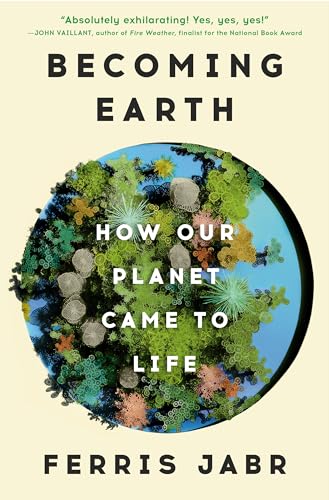
Becoming Earth : how our planet came to life / Ferris Jabr.
Material type: TextPublisher: New York : Random House, [2024]Edition: First editionDescription: xxiii, 269 pages : color illustrations ; 25 cmContent type:
 - text
- unmediated
- volume
- 9780593133972
- 570.1 23/eng/20240201
- QH367 .J23 2024
| Item type | Current library | Call number | Status | Date due | Barcode | Item holds | |
|---|---|---|---|---|---|---|---|
 Book
Book
|
Library | 570-2024 (Browse shelf(Opens below)) | Available | AT-ISTA#003158 |
Close shelf browser (Hides shelf browser)


Includes bibliographical references (pages 241-254) and index.
"The notion of a living world is one of humanity's oldest beliefs. Though scorned by scientists in the sixties and seventies, the facts supporting this concept have now become tenets of modern Earth system science, a relatively young field that studies the living and nonliving components of the planet as an integrated whole. Life did not evolve passively in response to its environment, as scientists have long assumed. Instead, it evolved with Earth, shaping its climate and terrain at every scale, one part in a great orchestra, in which non-living elements-the air, rocks, and water-are the instruments that life, in its multitudes, has emerged to play. Jabr transports the reader to some of the world's most extraordinary places--an underwater kelp forest on the coast of California, a vertiginous tower above the Amazon rainforest, and a former gold mine two miles below the Earth's surface--to explain how these symbiotic relationships evolved. He shows us how plants and other photosynthetic organisms help maintain the right level of atmospheric oxygen to support complex life. We see how microorganisms participate in many geological processes, producing new minerals and converting rock from one state to another; some scientists think they played a crucial role in forming the continents. In these pages we learn that large mammals maintain grasslands and prevent permafrost from melting; coral reefs and shellfish store huge amounts of carbon, buffer ocean acidity, improve water quality, and defend shorelines from severe weather; and so much more"-- Provided by publisher.