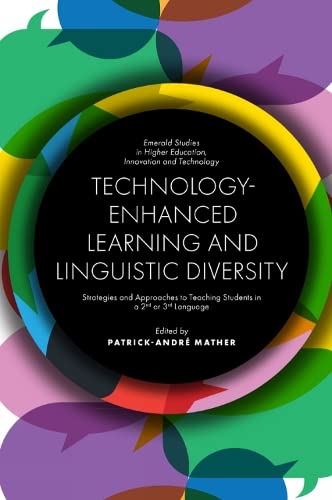
Technology-enhanced learning and linguistic diversity strategies and approaches to teaching students in a 2nd or 3rd language / edited by Patrick-Andre Mather.
Material type: TextSeries: Emerald studies in higher education, innovation and technologyPublisher: United Kingdom : Emerald Publishing, 2020Description: 1 online resourceContent type:
 - text
- computer
- online resource
- 9781839821288
- 1839821280
- 1839821302
- 9781839821301
- Second language acquisition
- Second language acquisition -- Study and teaching
- Educational technology
- Educational Technology
- Langue seconde -- Acquisition
- Langue seconde -- Acquisition -- Étude et enseignement
- Technologie éducative
- Bilingualism & multilingualism
- Education, Bilingual Education
- Educational technology
- Second language acquisition
- Second language acquisition -- Study and teaching
- 418.0071 23
- P118.2 .T43 2020
| Item type | Current library | Collection | Call number | Status | Date due | Barcode | Item holds | |
|---|---|---|---|---|---|---|---|---|
 eBook
eBook
|
e-Library | EBSCO Education | Available |
Chapter 1.Higher education and the multilingual classroom: how applied linguistics research can help design effective teaching strategies; Patrick-André Mather Part I: Third language acquisition and teaching: from theory to practice Chapter 2.The Additive Effect of Bilinguals' Metalinguistic Awareness in Additional Language Acquisition; Francesca D'Angelo Chapter 3.Learning Spanish and supporting Erasmus students' first language in the interactive classroom; Silvia Chireac Chapter 4.Translanguaging Strategies for Teaching Literature in a Multicultural Setting; Maria Teresa Martinez-Garcia, Patricia Arnold Chapter 5.On the implementation of language intercomprehension in the American university; Cedric J. Oliva, Alan Gomez Chapter 6.Technology-enhanced learning in the L3 German classroom; Sven-Ole Andersen Chapter 7.The intersection of language, culture and technology: Perceptions of L3 learning by L2 speakers of English; Chesla Ann Lenkaitis, Shannon M. Hilliker, Luis Y. Castañeda Chapter 8.Students' attitudes towards critical telecollaboration: A case study in an L2/L3 French classroom; Vincent Chanethom Part II: Teaching college and university-level content courses in an additional language Chapter 9.Technology-enhanced lesson plans for multilingual students; Anna Moni Chapter 10.Teacher-training programs in Physical Education for African-American and Hispanic students; Langston Clark, Carlos M. Cervantes Chapter 11.The Cumulative Curriculum Model for Content and Language Development in the Multilingual Classroom; Robb McCollum Chapter 12.Second and third language acquisition and the multilingual classroom: new insights for higher education; Patrick-André Mather.
Educators in Europe and the Americas traditionally have little formal training in applied linguistics, and yet they are increasingly faced with a growing multilingual student base. This book responds to the need to make the university community more aware of the unique experience of linguistically diverse students. Drawing on research and hands-on experience from both linguists and non-linguists who deal with students from different language backgrounds in their classroom, this book includes contributions which include linguistic research on 2nd and 3rd language acquisition, as well as case studies of specific challenges in teaching content courses in various disciplines, to offer a roadmap of how educators might facilitate the learning of their bilingual student cohort. Combining issues that have been studied separately within the fields of theoretical linguistics, pedagogy and information and communication technologies (ICT), the author presents a comprehensive overview across the areas of applied linguistics, foreign language teaching methodologies and technological tools to address multilingualism within the university classroom, and ultimately equip educators to meet a critical demand.
Added to collection customer.56279.3