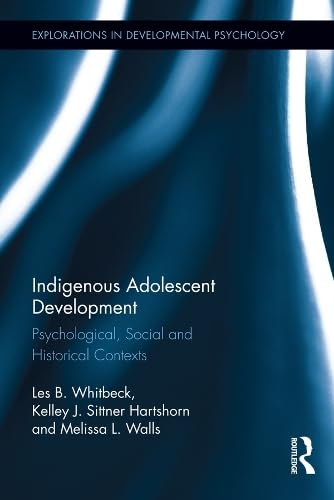
Indigenous Adolescent Development [electronic resource] : Psychological, Social and Historical Contexts.
Material type: TextSeries: Explorations in developmental psychology seriesPublication details: Hoboken : Taylor and Francis, 2014.Description: 1 online resource (480 p.)ISBN:
 - 9781134744190 (electronic bk.)
- 1134744196 (electronic bk.)
- 970.00497 23
- E98.S67 W48 2013
| Item type | Current library | Collection | Call number | Status | Date due | Barcode | Item holds | |
|---|---|---|---|---|---|---|---|---|
 eBook
eBook
|
e-Library | EBSCO Psychology | Available |
Description based upon print version of record.
Cover; Half Title; Title Page; Copyright Page; Table of Contents; List of Figures; List of Tables; Preface; Acknowledgments; Part I: The Healing Pathways Longitudinal Study; 1. The Reach of History; Indigenous Adolescent Development in Historical Context; Historical Contexts of Indigenous Adolescent Development; Confinement to Reservations and Reserves; Boarding Schools; The Developmental Significance of Historical Contexts; Historical Cultural Losses; Proximal Versus Distal Effects; Cultural Risk and Protective Factors; Enculturation as a Protective Factor; Discrimination
Growing Up on Reservations and ReservesTowards a Model of Indigenous Adolescent Development; 2. Ethical Research with Indigenous Communities; Tribal Sovereignty: Doing Research in Another Country; Access; Tribal Approval of the Research Process; Co-Ownership and Control of the Data; Tribal Preference; Tribal Sovereignty and Respect for the Culture; Identifying the Research Topic; True Partnerships: Involving Reservations and Reserves in the Research Effort; Community Confidentiality; Informed Consent; Mandatory Reporting Requirements
Reservations, Reserves, and Researchers: Maintaining the RelationshipPolitics and Political Change; Summary: The Partnership Process; 3. The Longitudinal Study; Study Sites; Sampling Procedures; Attrition Analyses; Interviewers, Interviewer Training, and Interview Procedures; Questionnaire Development; Diagnostic Schedules; Sample Characteristics; Summary and Discussion; Part II: Cultural Contexts of Development; 4. Traditions across Generations; Traditional Activities, Traditional Spirituality, and Cultural Identity; Language; The Adult Parents/Caretakers; The Adolescents
Traditional ActivitiesThe Adult Parents/Caretakers; The Adolescents; Traditional Spirituality; The Adult Parents/Caretakers; The Adolescents; Cultural Identity; The Adult Parents/Caretakers; The Adolescents; Adolescents and Cultural Traditions; Who is Traditional?; The Adults; Transmitting Traditions Across Generations; Bivariate Correlations between Parents/Caretakers and their Adolescent Children; Multivariate Analyses; Adolescent Traditional Activities; Adolescent Traditional Language Use; Adolescent Cultural Identity; Adolescent Traditional Spirituality; Discussion and Conclusions
5. Perceptions of Historical Cultural LossesThe Holocaust Analogy; The Problem of Measurement; A Life Course Conceptualization of Historical Cultural Losses; Daily or More Thoughts About Historical Cultural Losses; The Adults; Adults' Emotional Responses to Historical Cultural Losses; Adolescents; Correlates of Daily or More Thoughts About Historical Cultural Losses; Discussion and Conclusions; Part III: Family and Community Contexts; 6. Family Configurations and Family Influence; Family Structure; Measuring "Family Influence"; Family Monitoring; Family Warmth and Supportiveness; Approval
Discipline
This volume explores the first four waves of a longitudinal diagnostic study of Indigenous adolescents and their families. The first study of its kind, it calls attention to culturally specific risk factors that affect Indigenous (American Indian and Canadian First Nations) adolescent development and describe the historical and social contexts in which Indigenous adolescents come of age. It provides unique information on ethical research and development within Indigenous communities, psychiatric diagnosis at early and mid-adolescence, and suggestions for putting the findings into action thr.