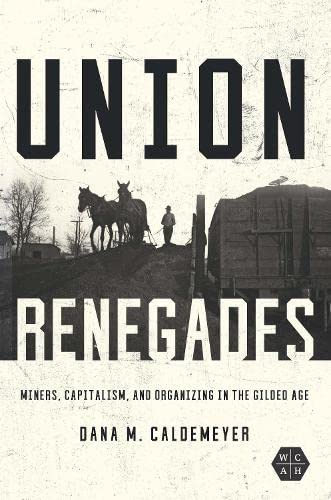
Union renegades : miners, capitalism, and organizing in the Gilded Age / Dana M. Caldemeyer.
Material type: TextSeries: Working class in American historyPublisher: Urbana : University of Illinois Press, [2021]Description: 1 online resource (viii, 231 pages)Content type:
 - text
- computer
- online resource
- 9780252052385
- 0252052382
- Coal miners -- Labor unions -- Middle West -- History -- 19th century
- Coal miners -- Middle West -- History -- 19th century
- Labor movement -- Middle West -- History -- 19th century
- Mineurs de charbon -- Syndicats -- Midwest (États-Unis) -- Histoire -- 19e siècle
- Mineurs de charbon -- Midwest (États-Unis) -- Histoire -- 19e siècle
- Mouvement ouvrier -- Midwest (États-Unis) -- Histoire -- 19e siècle
- SOCIAL SCIENCE -- General
- Coal miners
- Coal miners -- Labor unions
- Labor movement
- Middle West
- 1800-1899
- 331.88/122334097709034 23
- HD6515.M615 C45 2021
| Item type | Current library | Collection | Call number | Status | Date due | Barcode | Item holds | |
|---|---|---|---|---|---|---|---|---|
 eBook
eBook
|
e-Library | EBSCO Social Science | Available |
Includes bibliographical references (pages [171]-226) and index.
Deceived : producers in a dishonest world -- Undermined : winter diggers, union strikebreakers -- "Judases" : union "betrayal" and the aborted 1891 strike -- Outsiders : race and the exclusive politics of an inclusive union, 1892-1894 -- Unsettled : nonunion mobilization and the 1894 strike -- Wolves : fractured unions in the Gilded Age, 1894-1896.
In the late nineteenth century, Midwestern miners often had to decide if joining a union was in their interest. Arguing that these workers were neither pro-union nor anti-union, the author shows that they acted according to what they believed would benefit them and their families. As corporations moved to control coal markets and unions sought to centralize their organizations to check corporate control, workers were often caught between these institutions and sided with whichever one offered the best advantage in the moment. Workers chased profits while paying union dues, rejected national unions while forming local orders, and broke strikes while claiming to be union members. This pragmatic form of unionism differed from what union leaders expected of rank-and-file members, but for many workers, the choice to follow or reject union orders was a path to better pay, stability, and independence in an otherwise unstable age. Nuanced and eye-opening, this book challenges popular notions of workers' attitudes during the Gilded Age. -- Provided by publisher.
Online resource; title from digital title page (viewed on January 14, 2021).
Added to collection customer.56279.3