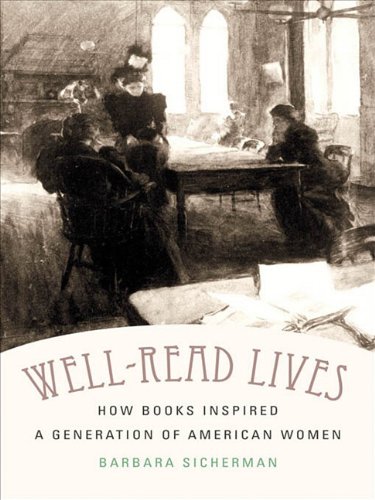
Well-read lives : how books inspired a generation of American women / Barbara Sicherman.
Material type: TextPublication details: Chapel Hill : University of North Carolina Press, ©2010.Description: 1 online resource (380 pages) : illustrationsContent type:
 - text
- computer
- online resource
- 9780807898246
- 0807898244
- 9781469604152
- 1469604159
- Women -- Books and reading -- Social aspects -- United States -- History -- 19th century
- Girls -- Books and reading -- Social aspects -- United States -- History -- 19th century
- Women and literature -- United States -- History -- 19th century
- Filles -- Livres et lecture -- Aspect social -- États-Unis -- Histoire -- 19e siècle
- Femmes et littérature -- États-Unis -- Histoire -- 19e siècle
- LITERARY CRITICISM -- Books & Reading
- SOCIAL SCIENCE -- Women's Studies
- Girls -- Books and reading -- Social aspects
- Women and literature
- Women -- Books and reading -- Social aspects
- United States
- 1800-1899
- 028/.9082 22
- Z1039.W65 S53 2010eb
| Item type | Current library | Collection | Call number | Status | Date due | Barcode | Item holds | |
|---|---|---|---|---|---|---|---|---|
 eBook
eBook
|
e-Library | EBSCO Social Science | Available |
Includes bibliographical references (pages 337-356) and index.
Reading Little women -- Women and the new cultural landscape of the Gilded Age -- Young women's ways of reading -- (Reading as) a family affair : the Hamiltons of Fort Wayne -- Reading and ambition : M. Carey Thomas and female heroism -- Working her way through culture : Jane Addams and literature's dual legacy -- Hull-House as a cultural space -- New books, new lives : Jewish immigrant women, reading, and identity -- With pen and voice : Ida B. Wells, race, literature, and politics.
In a compelling approach structured as theme and variations, the author offers insightful profiles of a number of accomplished women born in Americas Gilded Age who lost and found themselves in books, and worked out a new life purpose around them. Some women, like Edith and Alice Hamilton, M. Carey Thomas, and Jane Addams, grew up in households filled with books, while less privileged women found alternative routes to expressive literacy. Jewish immigrants Hilda Satt Polacheck, Rose Cohen, and Mary Antin acquired new identities in the English-language books they found in settlement houses and libraries, while African Americans like Ida B. Wells relied mainly on institutions of their own creation, even as they sought to develop a literature of their own. It is the author's contribution to show that however the skill of reading was acquired, under the right circumstances, adolescent reading was truly transformative in constructing female identity, stirring imaginations, and fostering ambition. With Little Women's Jo March often serving as a youthful model of independence, girls and young women created communities of learning, imagination, and emotional connection around literary activities in ways that helped them imagine, and later attain, public identities. Reading themselves into quest plots and into male as well as female roles, these young women went on to create an unparalleled record of achievement as intellectuals, educators, and social reformers. This study reveals the centrality of the eras culture of reading and sheds new light on these women's Progressive-Era careers.
Print version record.
Added to collection customer.56279.3