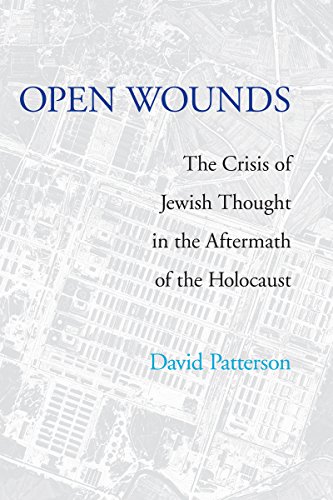
Open wounds : the crisis of Jewish thought in the aftermath of Auschwitz / David Patterson.
Material type: TextSeries: Pastora Goldner series in post-Holocaust studiesPublication details: Seattle : University of Washington Press, ©2006.Description: 1 online resource (xiii, 338 pages)Content type:
 - text
- computer
- online resource
- 9780295803166
- 0295803169
- 029598645X
- 9780295986456
- Holocaust, Jewish (1939-1945) -- Moral and ethical aspects
- Holocaust, Jewish (1939-1945) -- Influence
- Judaism -- 20th century
- Judaism -- Doctrines
- Holocaust (Jewish theology)
- Judaism -- History -- Modern period, 1750-
- Holocauste, 1939-1945 -- Aspect moral
- Judaïsme -- Histoire -- 20e siècle
- Judaïsme -- Doctrines
- Holocauste, 1939-1945 -- Aspect religieux -- Judaïsme
- HISTORY -- Holocaust
- SOCIAL SCIENCE -- Jewish Studies
- Judaism -- Modern period
- Ethics
- Holocaust (Jewish theology)
- Influence (Literary, artistic, etc.)
- Judaism
- Judaism -- Doctrines
- Jüdische Theologie
- Auswirkung
- Judenvernichtung
- Ethik
- Rezeption
- Jüdische Philosophie
- Jewish Holocaust (1939-1945)
- Since 1750
- 940.53/1814 22
- D804.3 .P3776 2006eb
- digitized 2010 HathiTrust Digital Library committed to preserve
| Item type | Current library | Collection | Call number | Status | Date due | Barcode | Item holds | |
|---|---|---|---|---|---|---|---|---|
 eBook
eBook
|
e-Library | EBSCO Social Science | Available |
Includes bibliographical references (pages 305-326) and index.
Introduction : the open wounds of Jewish thought -- The bankruptcy of modern and postmodern thought -- Ethical monotheism and Jewish thought -- The Holocaust and the Holy Tongue -- The sifrei kodesh and the Holocaust -- The Muselmann and the matter of the human being -- Jewish thought and a post-Holocaust tikkun haolam -- Mystical dimensions of post-Holocaust Jewish thought -- Though the Messiah may tarry -- Conclusion : no closure.
Print version record.
Use copy Restrictions unspecified star MiAaHDL
Electronic reproduction. [Place of publication not identified] : HathiTrust Digital Library, 2010. MiAaHDL
Master and use copy. Digital master created according to Benchmark for Faithful Digital Reproductions of Monographs and Serials, Version 1. Digital Library Federation, December 2002. MiAaHDL
http://purl.oclc.org/DLF/benchrepro0212
digitized 2010 HathiTrust Digital Library committed to preserve pda MiAaHDL
English.
"In this book, David Patterson sets out to describe why Jews must live - but especially think - in a way that is distinctly Jewish. For Patterson, the primary responsibility of post-Holocaust Jewish thought is to avoid thinking in the same categories that led to the attempted extermination of the Jewish people. The Nazis, he says, were not anti-Semitic because they were racists; they were racists because they were anti-Semitic, and their anti-Semitism was furthered by a Western ontological tradition that made God irrelevant by placing the thinking ego at the center of being."--BOOK JACKET.
Added to collection customer.56279.3