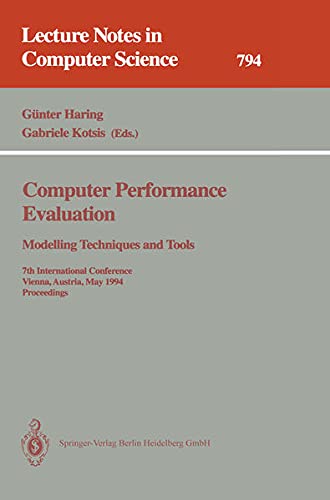
Computer performance evaluation : modelling techniques and tools : 7th international conference, Vienna, Austria, May 3-6, 1994 : proceedings / Günter Haring, Gabriele Kotsis, eds.
Material type: TextSeries: Lecture notes in computer science ; 794.Publication details: Berlin ; New York : Springer-Verlag, ©1994.Description: 1 online resource (x, 464 pages) : illustrationsContent type:
 - text
- computer
- online resource
- 9783540484165
- 3540484167
- Electronic digital computers -- Evaluation -- Congresses
- Ordinateurs -- Évaluation -- Congrès
- Electronic digital computers -- Evaluation
- Datenverarbeitungssystem
- Leistungsbewertung
- Rechnernetz
- Prestatietests
- Modellen
- Wetenschappelijke technieken
- Electronic digital computers -- Evaluation -- Congresses
- Digital computer simulation -- Congresses
- Ordinateurs -- Évaluation
- Wien <1994>
- 004.24/01/1 20
- QA76.9.E94 C6496 1994
- 54.33
- SS 4800
- ST 276
- 28
- DAT 280f
| Item type | Current library | Collection | Call number | Status | Date due | Barcode | Item holds | |
|---|---|---|---|---|---|---|---|---|
 eBook
eBook
|
e-Library | eBook LNCS | Available |
"The 7th International Conference on Modelling Techniques and Tools for Computer Performance Evaluation"--Preface.
Includes bibliographical references.
Performance evaluation, reliability, and performability are key factors in the development and improvement of computer systems and computer networks. This volume contains the 25 accepted and invited papers presented at the 7th International Conference on Modelling Techniques and Tools for Computer Performance Evaluation. The papers focus on new techniques and the extension of existing techniques for performance and reliability analysis. Tools to support performance and reliability modelling and measurement in all kinds of applications and environments are presented, and the practicability and generality of the approaches are emphasized. The volume summarizes the state of the art and points out future demands and challenges, and will interest both scientists and practitioners.
Techniques and tools for reliability and performance evaluation: Problems and perspectives -- Experimental analysis of parallel systems: Techniques and open problems -- Performance experiences of the Barcelona Olympic games computer system -- Performance tools on intel scalable high performance computing systems -- Modelling aspects of model-based dynamic QoS management by the Performability Manager -- Waiting time distributions for processor sharing queues with state-dependent arrival and service rates -- Queueing models of parallel applications: The Glamis methodology -- Automatic scalability analysis of parallel programs based on modeling techniques -- Simulation of ATM computer networks with CLASS -- NetSim -- A tool for modeling the performance of circuit switched multicomputer networks -- ATMSWSIM An efficient, portable and expandable ATM SWitch SIMulator tool -- A model for performance estimation in a multistreamed superscalar processor -- Accelerating the evaluation of parallel program performance models using distributed simulation -- An algorithm for off-line detection of phases in execution profiles -- Experiences on SIMD massively parallel GSPN analysis -- PAPS -- The parallel program performance prediction toolset -- qcomp: A tool for assessing online transaction processing scalability -- QPN-Tool for qualitative and quantitative analysis of queueing Petri nets -- Software architecture of the EPOCA integrated environment -- The PEPA workbench: A tool to support a process algebra-based approach to performance modelling -- On the accuracy of memory reference models -- Automatically estimating network contention of parallel programs -- Modelling of communication contention in multiprocessors -- Using Interval Timed Coloured Petri Nets to calculate performance bounds -- Analyzing PICL trace data with MEDEA.