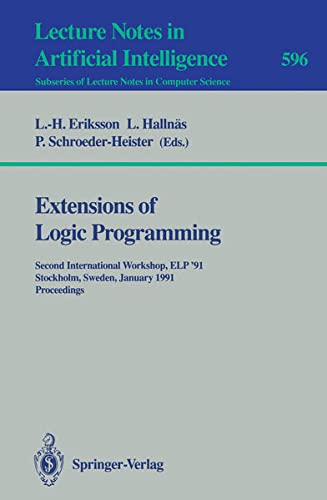
Extensions of logic programming : second international workshop, ELP '91, Stockholm, Sweden, January 27-29, 1991, proceedings / L.H. Eriksson, L. Hallnäs, P. SchroederHeister (eds.).
Material type: TextSeries: Lecture notes in computer science ; 596. | Lecture notes in computer science. Lecture notes in artificial intelligence.Publisher: Berlin ; New York : Springer-Verlag, ©1992Description: 1 online resource (369 pages) : illustrationsContent type:
 - text
- computer
- online resource
- 9783540471141
- 3540471146
- ELP '91
- 005.1 20
- QA76.63 .E98 1992
- 54.51
| Item type | Current library | Collection | Call number | Status | Date due | Barcode | Item holds | |
|---|---|---|---|---|---|---|---|---|
 eBook
eBook
|
e-Library | eBook LNCS | Available |
Includes bibliographical references.
Online resource; title from PDF title page (SpringerLink, viewed August 20, 2013).
This volume contains papers presented at the second international workshop on extensions of logic programming, which was held at the Swedish Institute of Computer Science, Stockhom, January 27-29, 1991. The 12 papers describe and discuss several approaches to extensions of logic programming languages such as PROLOG, as well as connections between logic programming and functional programming, theoretical foundations of extensions, applications, and programming methodologies. The first workshop in this series was held in T}bingen in 1989 and its proceedings areavailable as LNCS 475. The third workshop will be held in Bologna in 1992.
Methodology and programming techniques in GCLA II -- Extended logic-plus-functional Programming -- Open logic theories -- A finitary version of the calculus of partial inductive definitions -- A logic programming approach to implementing higher-Order term rewriting -- An overview of the Andorra Kernel Language -- Logical and computational invariants of programs -- Implementing?-calculus reduction strategies in extended logic programming languages -- Terminological reasoning and partial inductive definitions -- GCLA II A definitional approach to control -- Natural semantics and some of its meta-theory in Elf -- The near-Horn approach to disjunctive logic programming.