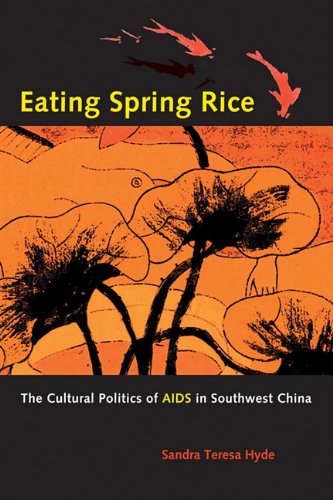
Eating spring rice : the cultural politics of AIDS in Southwest China / Sandra Teresa Hyde.
Material type: TextPublication details: Berkeley : University of California Press, ©2007.Description: 1 online resource (xix, 271 pages) : illustrations, mapsContent type:
 - text
- computer
- online resource
- 9780520939486
- 0520939484
- 9781429494571
- 1429494573
- AIDS (Disease) -- China -- Yunnan Sheng
- AIDS (Disease) -- Government policy -- China -- Yunnan Sheng
- AIDS (Disease) -- Social aspects -- China -- Yunnan Sheng
- Social change
- Prostitution
- Acquired Immunodeficiency Syndrome -- ethnology
- Public Policy
- Sexual Behavior
- Social Change
- Socioeconomic Factors
- Sex Work
- China
- Sida -- Chine -- Yunnan (Sheng)
- Sida -- Politique gouvernementale -- Chine -- Yunnan (Sheng)
- Sida -- Aspect social -- Chine -- Yunnan (Sheng)
- Changement social
- Prostitution
- prostitution
- MEDICAL -- AIDS & HIV
- HEALTH & FITNESS -- Diseases -- AIDS & HIV
- SOCIAL SCIENCE -- Anthropology -- Cultural
- AIDS (Disease)
- AIDS (Disease) -- Government policy
- AIDS (Disease) -- Social aspects
- China -- Yunnan Sheng
- 362.196/97920095135 22
- RA643.86.C62 H93 2007eb
- 2007 C-495
- WC 503.7
| Item type | Current library | Collection | Call number | Status | Date due | Barcode | Item holds | |
|---|---|---|---|---|---|---|---|---|
 eBook
eBook
|
e-Library | EBSCO Social Science | Available |
Includes bibliographical references (pages 231-255) and index.
Print version record.
Introduction: The cultural politics of AIDS in postreform China -- The aesthetics of statistics -- Everyday AIDS practices : risky bodies and contested borders -- Sex tourism and performing ethnicity in Jinghong -- Eating spring rice : transactional sex in a beauty salon -- A sexual hydraulic : commercial "sex workers" and condoms -- Moral economies of sexuality -- Epilogue: What is to be done?
Eating Spring Rice is the first major ethnographic study of HIV/AIDS in China. Drawing on more than a decade of ethnographic research (1995-2005), primarily in Yunnan Province, Sandra Teresa Hyde chronicles the rise of the HIV epidemic from the years prior to the Chinese government's acknowledgement of this public health crisis to post-reform thinking about infectious-disease management. Hyde combines innovative public health research with in-depth ethnography on the ways minorities and sex workers were marked as the principle carriers of HIV, often despite evidence to the contrary. Hyde approaches HIV/AIDS as a study of the conceptualization and the circulation of a disease across boundaries that requires different kinds of anthropological thinking and methods. She focuses on "everyday AIDS practices" to examine the links between the material and the discursive representations of HIV/AIDS. This book illustrates how representatives of the Chinese government singled out a former kingdom of Thailand, Sipsongpanna, and its indigenous ethnic group, the Tai-Lüe, as carriers of HIV due to a history of prejudice and stigma, and to the geography of the borderlands. Hyde poses questions about the cultural politics of epidemics, state-society relations, Han and non-Han ethnic dynamics, and the rise of an AIDS public health bureaucracy in the post-reform era.
WorldCat record variable field(s) change: 650