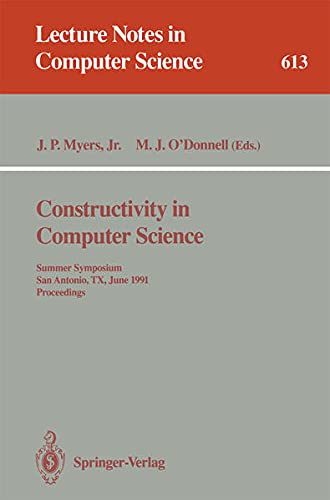
Constructivity in computer science : summer symposium, San Antonio, TX, June 19-22, 1991, proceedings / J.P. Myers, Jr., M.J. O'Donnell, eds.
Material type: TextSeries: Lecture notes in computer science ; 613.Publisher: Berlin ; New York : Springer-Verlag, ©1992Description: 1 online resource (x, 246 pages) : illustrationsContent type:
 - text
- computer
- online resource
- 9783540472650
- 3540472657
- Computer science -- Mathematics -- Congresses
- Informatique -- Mathématiques -- Congrès
- Computer science -- Mathematics
- Datenverarbeitung
- Konstruktive Methode
- Kongress
- Konstruierbarkeit Mathematik
- Wiskundige logica
- Programming languages (Electronic computers) -- Semantics -- Congresses
- Constructive mathematics -- Congresses
- Automatic theorem proving -- Congresses
- Informatique -- Congrès
- 005.13/1 20
- QA76.9.M35 C655 1992
- 31.10
- 54.10
- SS 4800
- DAT 549f
- MAT 036f
- 54.51
- 28
- digitized 2012 HathiTrust Digital Library committed to preserve
| Item type | Current library | Collection | Call number | Status | Date due | Barcode | Item holds | |
|---|---|---|---|---|---|---|---|---|
 eBook
eBook
|
e-Library | eBook LNCS | Available |
Contains papers presented at the Symposium on Constructivity in Computer Science held in San Antonio, Tex., June 19-22, 1991, sponsored by Trinity University, the University of Chicago, and the Association for Symbolic Logic.
Includes bibliographical references and index.
Use copy Restrictions unspecified star MiAaHDL
Electronic reproduction. [Place of publication not identified] : HathiTrust Digital Library, 2012. MiAaHDL
Master and use copy. Digital master created according to Benchmark for Faithful Digital Reproductions of Monographs and Serials, Version 1. Digital Library Federation, December 2002. MiAaHDL
http://purl.oclc.org/DLF/benchrepro0212
digitized 2012 HathiTrust Digital Library committed to preserve pda MiAaHDL
Mathematicians have long recognized the distinction between an argument showing that an interesting object exists and a procedure for actually constructing the object. Computer science adds a new dimension of interest in constructivity, since a computer program is a formal description of a constructive procedure that can be executed automatically. It has beenover a decade since a conference was devoted to constructivity, and never before has one been held specifically relating computer science to constructivity. Thus, this proceedings volume is the most concentrated offering ever produced of the diverse ways in which constructivity and computer science are related. The papers cover semantics and type theory, logic and theorem proving, real and complex analysis, topology and combinatorics, nonconstructive graph-theoretical techniques, and curriculum and pedagogic issues. The book offers a concentrated view of the many ways in which constructivity has assumed importance in computer science, and contains results available nowhere else.
Print version record.
Connecting formal semantics to constructive intuitions -- Kripke semantics for dependent type theory and realizability interpretations -- Reflective semantics of constructive type theory -- Are subsets necessary in Martin-Löf type theory? -- Development transformation based on higher order type theory -- Classical proofs as programs: How, what and why -- Classical type theory -- Axiomatization of calculus of constructions -- A logical view of assignments -- Constructivity issues in graph algorithms -- Constructive topology and combinatorics -- Implementing constructive real analysis (preliminary report) -- Examples of semicomputable sets of real and complex numbers -- Bringing mathematics education into the algorithmic age -- The type structure of CAT -- A simple and powerful approach for studying constructivity, computability, and complexity.