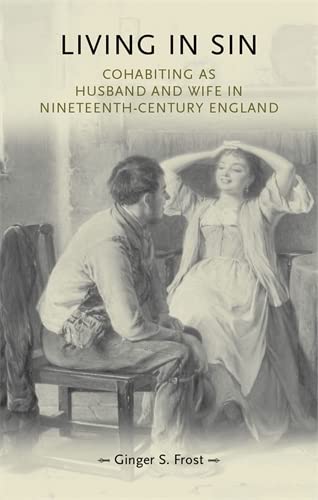
Living in sin : cohabiting as husband and wife in nineteenth-century England / Ginger S. Frost.
Material type: TextSeries: Gender in historyPublication details: Manchester New York : Manchester University Press ; New York : Distributed exclusively in the USA by Palgrave Macmillan, 2008.Description: 1 online resource (vii, 264 pages)Content type:
 - text
- computer
- online resource
- 9781847791412
- 1847791417
- 9781781700723
- 1781700729
- Unmarried couples -- England -- History -- 19th century
- Couples non mariés -- Angleterre -- Histoire -- 19e siècle
- SOCIAL SCIENCE -- Sociology -- Marriage & Family
- HISTORY -- Europe -- Great Britain
- Unmarried couples
- England
- Freie Liebe -- Grossbritannien -- Geschichte 19. Jh
- Konkubinat -- Grossbritannien -- Geschichte 19. Jh
- Partnerschaft -- Single -- Grossbritannien -- Geschichte 19. Jh
- Single -- Partnerschaft -- Grossbritannien -- Geschichte 19. Jh
- 1800-1899
- 306.841094209034 22
- HQ803.5 .F76 2008
- digitized 2010 HathiTrust Digital Library committed to preserve
| Item type | Current library | Collection | Call number | Status | Date due | Barcode | Item holds | |
|---|---|---|---|---|---|---|---|---|
 eBook
eBook
|
e-Library | EBSCO Social Science | Available |
Cohabitation, illegitimacy, and the law in England, 1750-1914 -- Violence and cohabitation in the courts -- Affinity and consanguinity -- Bigamy and cohabitation -- Adulterous cohabitation -- The 'other Victorians' : the demimonde and the very poor -- Cross-class cohabitation -- Radical couples, 1790-1850 -- Radical couples, 1850-1914.
Includes bibliographical references (pages 236-254) and index.
"Living in sin is the first book-length study of cohabitation in nineteenth-century England, based on research into the lives of hundreds of couples. 'Common-law' marriages did not have any legal basis, so the Victorian courts had to wrestle with unions that resembled marriage in everyway, yet did not meet its most basic requirements. Unsurprisingly, the courts reacted with ambiguity, upholding cohabitation in some instances and punishing it in others. By challenging the definition of marriage through their actions, couples reformed the state's dealings with it; nevertheless, cohabitees never had legal status and this had serious repercussions for women and children." "The majority of those who lived in irregular unions did so because they could not marry legally. Others, though, chose not to marry, either from indifference, class differences, or because they dissented from marriage for philosophical reasons. This book looks at each motivation in turn, highlighting class, gender and generational differences, as well as the reactions of wider kin and community. Cohabitation was not the same as marriage, but many family and friends accepted at least some irregular unions, most readily in the working classes. At the same time, the sexual double standard meant that women suffered more than men from the disadvantages of 'free unions'." "Frost shows how these couples slowly widened the definition of legal marriage, preparing the way for the more substantial changes of the twentieth century, making this a valuable resource for all those interested in Gender and Social History."--Jacket
Use copy Restrictions unspecified star MiAaHDL
Electronic reproduction. [Place of publication not identified] : HathiTrust Digital Library, 2010. MiAaHDL
Master and use copy. Digital master created according to Benchmark for Faithful Digital Reproductions of Monographs and Serials, Version 1. Digital Library Federation, December 2002. MiAaHDL
http://purl.oclc.org/DLF/benchrepro0212
digitized 2010 HathiTrust Digital Library committed to preserve pda MiAaHDL
Print version record.
English.
Legal Deposit; Only available on premises controlled by the deposit library and to one user at any one time; The Legal Deposit Libraries (Non-Print Works) Regulations (UK). WlAbNL
Added to collection customer.56279.3