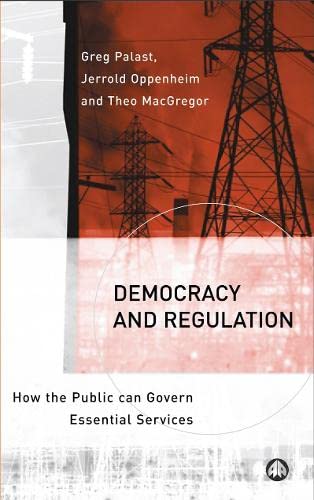
Democracy and regulation : how the public can govern essential services / Greg Palast, Jerrold Oppenheim and Theo MacGregor.
Material type: TextPublisher: London ; Sterling, Virginia : Pluto Press, 2003Copyright date: ©2003Description: 1 online resource (xx, 233 pages) : illustrationsContent type:
 - text
- still image
- computer
- online resource
- 9781849641609
- 1849641609
- Public utilities -- Deregulation -- United States
- Public utilities -- State supervision -- United States
- Public utilities -- Rates -- United States
- Privatization -- United States
- Democracy -- United States
- Services publics -- Déréglementation -- États-Unis
- Services publics -- Contrôle de l'État -- États-Unis
- Services publics -- Tarifs -- États-Unis
- Privatisation -- États-Unis
- POLITICAL SCIENCE -- Public Policy -- Economic Policy
- BUSINESS & ECONOMICS -- Government & Business
- BUSINESS & ECONOMICS -- Development -- Economic Development
- BUSINESS & ECONOMICS -- Development -- Business Development
- BUSINESS & ECONOMICS -- Structural Adjustment
- BUSINESS & ECONOMICS -- Development -- General
- SOCIAL SCIENCE -- Sociology -- General
- Democracy
- Privatization
- Public utilities -- Deregulation
- Public utilities -- Rates
- Public utilities -- State supervision
- United States
- Deregulierung
- Versorgungsbetrieb
- Öffentliches Unternehmen
- USA
- Dienstensector
- Privatisering
- Regulering
- Dérèglementation
- Services publics
- Démocratie
- Privatisation
- Contrôle de l'État
- États-Unis
- 338.973/05 22
- HD2766 .P33 2003eb
- 83.52
- MG 70020
- digitized 2010 HathiTrust Digital Library committed to preserve
| Item type | Current library | Collection | Call number | Status | Date due | Barcode | Item holds | |
|---|---|---|---|---|---|---|---|---|
 eBook
eBook
|
e-Library | EBSCO Business | Available |
Includes bibliographical references (pages 198-223) and index.
Use copy Restrictions unspecified star MiAaHDL
Electronic reproduction. [Place of publication not identified] : HathiTrust Digital Library, 2010. MiAaHDL
Master and use copy. Digital master created according to Benchmark for Faithful Digital Reproductions of Monographs and Serials, Version 1. Digital Library Federation, December 2002. MiAaHDL
http://purl.oclc.org/DLF/benchrepro0212
digitized 2010 HathiTrust Digital Library committed to preserve pda MiAaHDL
1. Secrecy, democracy and regulation -- 2. Regulating in public -- 3. Competition as substitute for regulation? Britain to California -- 4. Re-regulation is not deregulation -- 5. The open regulatory process -- 6. Social pricing -- 7. Issues that are publicly decided -- 8. An alternative : democratic negotiations -- 9. Be there : a guide to public participation -- 10. A history of democratic utility regulation in the US -- 11. Regulating the multinational utility -- 12. Failed experiments in the UK and the US -- 13. The biggest failures : California and Enron -- 14. International democracy : developing and developed countries -- 15. Conclusion.
Essential services are being privatised the world over. Whether it's water, gas, electricity or the phone network, everywhere from Sao Paulo in Brazil to Leeds in the UK is following the US economic model and handing public services over to private companies whose principal interest is raising prices. Yet it's one of the world's best kept secrets that Americans pay astonishingly little for high quality public services. Uniquely in the world, every aspect of US regulation is wide open to the public. How is this done and why has this process not taken root elsewhere? How is regulation threatened even in the US? And what power does the public have to ensure that services are regulated along these US lines?This book, based on work for the United Nations International Labour Organisation and written by experts with unrivalled practical experience in utility regulation, is the first step-by-step guide to the way that public services are regulated in the United States. It explains how decisions are made by public debate in a public forum. Profits and investments of private companies are capped, and companies are forced to reduce prices for the poor, fund environmental investments and open themselves to financial inspection. In a world where privatisation has so often led to economic disaster -- in Peru, telephone charges increased by 3000%; in Rio de Janeiro, 40% of electricity workers lost their jobs; in Britain water prices rose by 58% -- this book is essential reading. Palast, Oppenheim and MacGregor examine what's right with the traditional American system, why regulation elsewhere has failed, and -- most importantly -- what can be done to fix it.
Greg Palast is an investigative journalist whose articles have appeared in the New York Times, Observer, Washington Post, and The Nation and Salon.com. He has appeared on BBC Newsnight as special investigations reporter. He is the winner Financial Times David Thomas Prize, for Industrial Society Investigative Story of the Year. He has also been nominated by the UK Press Association as Business Writer of the Year. His books include The Best Democracy Money Can Buy (Pluto, 2002) and Democracy and Regulation: How the Public Can Govern Essential Services (Pluto, 2003).
English.
Print version record.
Added to collection customer.56279.3