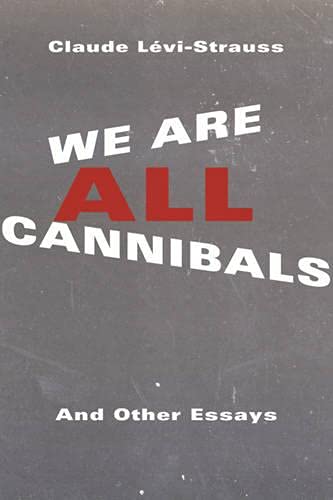
We are all cannibals and other essays / Claude Lévi-Strauss ; with a foreword by Maurice Olender ; translated by Jane Marie Todd.
Material type: TextLanguage: English Original language: French Series: European perspectivesPublisher: New York : Columbia University Press, [2016]Description: 1 online resource (viii, 159 pages)Content type:
 - text
- computer
- online resource
- 9780231541268
- 0231541260
- 9780231541268
- 9780231541268
- Nous sommes tous des cannibales. English
- 301 23
- GN362 .L472513 2016eb
| Item type | Current library | Collection | Call number | Status | Date due | Barcode | Item holds | |
|---|---|---|---|---|---|---|---|---|
 eBook
eBook
|
e-Library | EBSCO Social Science | Available |
Translated from the French.
Includes bibliographical references and index.
Online resource; title from PDF title page (EBSCO, viewed March 25, 2016).
Santa burned as a heretic, 1952 -- We are all cannibals, 1989-2000 -- 1. "Topsy-turvydom" -- 2. Is there only one type of development? -- 3. Social problems: ritual female excision and medically assisted reproduction -- 4. Presentation of a book by its author -- 5. The ethnologist's jewels -- 6 Portraits of artists -- 7. Montaigne and America -- 8. Mythic thought and scientific thought -- 9. We are all cannibals -- 10. Auguste Comte and Italy -- 11. Variations on the theme of a painting by Poussin -- 12. Female sexuality and the origin of society -- 13. A lesson in wisdom from mad cows -- 14. The return of the maternal uncle -- 15. Proof by new myth -- 16. Corsi e ricorsi: in Vico's wake.
"On Christmas Eve 1951, Santa Claus was hanged and then publicly burned outside of the Cathedral of Dijon in France. That same decade, ethnologists began to study the Indigenous cultures of central New Guinea, and found men and women affectionately consuming the flesh of the ones they loved. "Everyone calls what is not their own custom barbarism," said Montaigne. In these essays, Claude Lévi-Strauss shows us behavior that is bizarre, shocking, and even revolting to outsiders but consistent with a people's culture and context. These essays relate meat eating to cannibalism, female circumcision to medically assisted reproduction, and mythic thought to scientific thought. They explore practices of incest and patriarchy, nature worship versus man-made material obsessions, the perceived threat of art in various cultures, and the innovations and limitations of secular thought. Lévi-Strauss measures the short distance between "complex" and "primitive" societies and finds a shared madness in the ways we enact myth, ritual, and custom. Yet he also locates a pure and persistent ethics that connects the center of Western civilization to far-flung societies and forces a reckoning with outmoded ideas of morality and reason." -- Provided by the Publisher.
Added to collection customer.56279.3