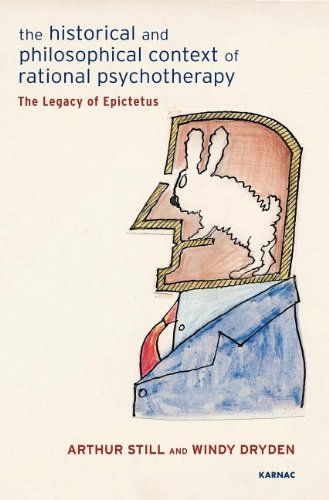
The Historical and Philosophical Context of Rational Psychotherapy : the Legacy of Epictetus / Arthur Still and Windy Dryden.
Material type: TextPublication details: London : Karnac Books, 2012.Description: 1 online resource (xxvii, 237 pages)Content type:
 - text
- computer
- online resource
- 9781849409926
- 1849409927
- 1280686138
- 9781280686139
- Epictetus
- Epictetus
- Epictetus
- Psychotherapy
- Stoics
- Rational emotive behavior therapy
- Medicine -- Philosophy
- Psychotherapy, Rational-Emotive -- history
- Psychotherapy, Rational-Emotive
- Philosophy, Medical
- Stoïcisme
- Psychothérapie rationnelle-émotive
- Médecine -- Philosophie
- stoicism
- MEDICAL -- Psychiatry -- General
- Psychotherapy
- Stoics
- 616.891 22
- RC480 .D384 2012
- 2012 G-521
- WM 420.5.P8
| Item type | Current library | Collection | Call number | Status | Date due | Barcode | Item holds | |
|---|---|---|---|---|---|---|---|---|
 eBook
eBook
|
e-Library | EBSCO Psychology | Available |
Includes bibliographical references (pages 209-214) and index.
COVER; CONTENTS; ACKNOWLEDGEMENTS; ABOUT THE AUTHORS; INTRODUCTION; CHAPTER ONE The place of rationality in Stoicism and REBT; CHAPTER TWO Ellis and Epictetus: dialogue vs. method in psychotherapy; CHAPTER THREE The intellectual origins of Rational Psychotherapy: twentieth-century writers; CHAPTER FOUR REBT and rationality: philosophical approaches; CHAPTER FIVE Rationality and the shoulds; CHAPTER SIX When did a psychologist last discuss "chagrin"? American psychology's continuing moral project; CHAPTER SEVEN The social psychology of "pseudoscience": a brief history.
CHAPTER EIGHT Historical aspects of mindfulness and self-acceptance in psychotherapyCHAPTER NINE Marginalisation is not unbearable; is it even undesirable?; CONCLUSIONS; REFERENCES; INDEX.
This book brings together the papers written by the authors over the last fifteen years on the historical and philosophical foundations of Albert Ellis' Rational Psychotherapy (later Rational Emotive Behavior Therapy, REBT) and its relationship to Stoicism, especially the later practical form represented by Epictetus. It goes beneath the well known similarities between Stoic "spiritual exercises" and modern psychotherapy, to look at the cause of these similarities. These lie in the conceptual continuities that connect the Stoics and other ancient philosophies with the modern cultural framew.
Print version record.
WorldCat record variable field(s) change: 650