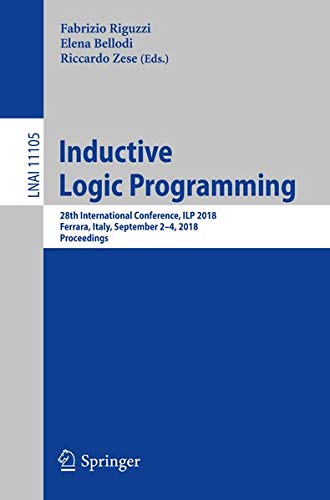
Inductive logic programming : 28th International Conference, ILP 2018, Ferrara, Italy, September 2-4, 2018, Proceedings / Fabrizio Riguzzi, Elena Bellodi, Riccardo Zese (eds.).
Material type: TextSeries: Lecture notes in computer science ; 11105. | Lecture notes in computer science. Lecture notes in artificial intelligence. | LNCS sublibrary. SL 7, Artificial intelligence.Publisher: Cham, Switzerland : Springer, 2018Description: 1 online resource (ix, 173 pages) : illustrationsContent type:
 - text
- computer
- online resource
- 9783319999609
- 3319999605
- 9783319999616
- 3319999613
- ILP 2018
- Logic programming -- Congresses
- Induction (Logic) -- Congresses
- Machine learning -- Congresses
- Programmation logique -- Congrès
- Induction (Logique) -- Congrès
- Apprentissage automatique -- Congrès
- Computer programming -- software development
- Programming & scripting languages: general
- Public administration
- Artificial intelligence
- Computers -- Programming -- General
- Computers -- Programming Languages -- General
- Computers -- Data Processing
- Computers -- Intelligence (AI) & Semantics
- Induction (Logic)
- Logic programming
- Machine learning
- 005.1/15 23
- QA76.63 .I47 2018eb
| Item type | Current library | Collection | Call number | Status | Date due | Barcode | Item holds | |
|---|---|---|---|---|---|---|---|---|
 eBook
eBook
|
e-Library | eBook LNCS | Available |
International conference proceedings.
Includes author index.
Online resource; title from PDF title page (SpringerLink, viewed August 28, 2018).
Derivation reduction of metarules in meta-interpretive learning.-Large-Scale Assessment of Deep Relational Machines.- How much can experimental cost be reduced in active learning of agentstrategies?.-Diagnostics of Trains with Semantic Diagnostics Rules.-The game of Bridge: a challenge for ILP.-Sampling-Based SAT/ASP Multi-Model Optimization as a Framework for Probabilistic Inference.-Explaining Black-box Classifiers with ILP -- Empowering LIME with Alephto Approximate Non-linear Decisions with Relational Rules.-Learning Dynamics with Synchronous, Asynchronous and General Semantics.-Was the Year 2000 a Leap Year? Step-wise Narrowing Theories with Metagol.-Targeted End-to-end Knowledge Graph Decomposition.
This book constitutes the refereed conference proceedings of the 28th International Conference on Inductive Logic Programming, ILP 2018, held in Ferrara, Italy, in September 2018. The 10 full papers presented were carefully reviewed and selected from numerous submissions. Inductive Logic Programming (ILP) is a subfield of machine learning, which originally relied on logic programming as a uniform representation language for expressing examples, background knowledge and hypotheses. Due to its strong representation formalism, based on first-order logic, ILP provides an excellent means for multi-relational learning and data mining, and more generally for learning from structured data.