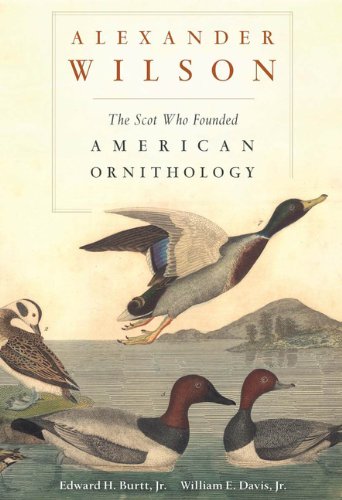
Alexander Wilson : the Scot who founded American ornithology / Edward H. Burtt, Jr., William E. Davis, Jr.
Material type: TextPublication details: Cambridge, Massachusetts : The Belknap Press of Harvard University Press, 2013.Description: 1 online resource (x, 444 pages) : illustrations (chiefly color)Content type:
 - text
- computer
- online resource
- 9780674073739
- 0674073738
- Wilson, Alexander, 1766-1813
- Wilson, Alexander, 1766-1813. American ornithology -- Illustrations
- Wilson, Alexander, 1766-1813
- Wilson, Alexander 1766-1813
- Ornithologists -- United States -- Biography
- Ornithology -- United States -- History
- Birds -- United States -- Pictorial works
- Ornithologues -- États-Unis -- Biographies
- Ornithologie -- États-Unis -- Histoire
- Oiseaux -- États-Unis -- Ouvrages illustrés
- BIOGRAPHY & AUTOBIOGRAPHY -- General
- NATURE -- Animals -- Birds
- NATURE -- Birdwatching Guides
- SCIENCE -- Life Sciences -- Zoology -- Ornithology
- Birds
- Ornithologists
- Ornithology
- United States
- Ornithologie
- 598.092 23
- QL31.W7 B87 2013eb
| Item type | Current library | Collection | Call number | Status | Date due | Barcode | Item holds | |
|---|---|---|---|---|---|---|---|---|
 eBook
eBook
|
e-Library | EBSCO Science | Available |
Includes bibliographical references (pages 429-432) and index.
Themes in Wilson's life and writings -- A varied life -- Illustrating American ornithology -- Pioneer ornithologist -- Wilson's legacy -- Appendix A. On the shoulders of giants : Wilson's predecessors -- Appendix B. Wilson's contemporaries and correspondents.
Print version record.
Audubon was not the father of American ornithology. That honorific belongs to Alexander Wilson, whose encyclopedic American Ornithology established a distinctive approach that emphasized the observation of live birds. In the first full-length study to reproduce all of Wilson's unpublished drawings for the nine-volume Ornithology, Edward Burtt and William Davis illustrate Wilson's pioneering and, today, underappreciated achievement as the first ornithologist to describe the birds of the North American wilderness. Abandoning early ambitions to become a poet in the mold of his countryman Robert Burns, Wilson emigrated from Scotland to settle near Philadelphia, where the botanist William Bartram encouraged his proclivity for art and natural history. Wilson traveled 12,000 miles on foot, on horseback, in a rowboat, and by stage and ship, establishing a network of observers along the way. He wrote hundreds of accounts of indigenous birds, discovered many new species, and sketched the behavior and ecology of each species he encountered. Drawing on their expertise in both science and art, Burtt and Davis show how Wilson defied eighteenth-century conventions of biological illustration by striving for realistic depiction of birds in their native habitats. He drew them in poses meant to facilitate identification, making his work the model for modern field guides and an inspiration for Audubon, Spencer Fullerton Baird, and other naturalists who followed. On the bicentennial of his death, this beautifully illustrated volume is a fitting tribute to Alexander Wilson and his unique contributions to ornithology, ecology, and the study of animal behavior.
On the bicentennial of his death, this beautifully illustrated volume pays tribute to the Scot who became the father of American ornithology. Alexander Wilson made unique contributions to ecology and animal behavior. His drawings of birds in realistic poses in their natural habitat inspired Audubon, Spencer Fullerton Baird, and other naturalists.
In English.
Added to collection customer.56279.3