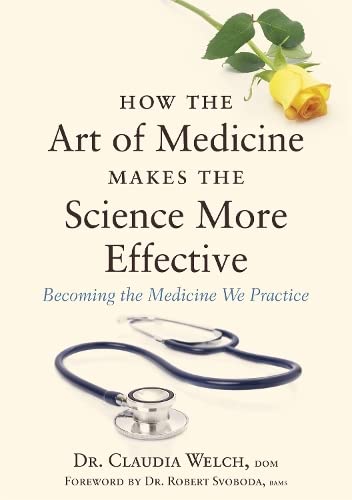
How the art of medicine makes the science more effective : becoming the medicine we practice / Dr. Claudia Welch ; foreword by Dr. Robert Svoboda.
Material type: TextPublisher: London : Singing Dragon, 2015Description: 1 online resourceContent type:
 - text
- computer
- online resource
- 9780857011817
- 0857011812
- Medical personnel -- Attitudes
- Medical personnel and patient
- Clinical competence
- Physician and patient
- Attitude of Health Personnel
- Physicians -- standards
- Clinical Competence
- Physician's Role
- Physician-Patient Relations
- Professional-Patient Relations
- Personnel médical -- Attitudes
- Relations personnel médical-patient
- Compétence clinique
- Relations médecin-patient
- Chinese Medicine & Acupuncture
- Ayurvedic Therapies
- Complementary Medicine
- Medicine
- HEALTH & FITNESS -- Holism
- HEALTH & FITNESS -- Reference
- MEDICAL -- Alternative Medicine
- MEDICAL -- Atlases
- MEDICAL -- Essays
- MEDICAL -- Family & General Practice
- MEDICAL -- Holistic Medicine
- MEDICAL -- Osteopathy
- Medical personnel -- Attitudes
- Medical personnel and patient
- Clinical competence
- Physician and patient
- Physicians
- 610.69 23
- R690
- W 62
| Item type | Current library | Collection | Call number | Status | Date due | Barcode | Item holds | |
|---|---|---|---|---|---|---|---|---|
 eBook
eBook
|
e-Library | EBSCO Medical | Available |
Includes bibliographical references and index.
Preface and Notes. 1. The Art of Medicine and the Qualities of a Physician. Part I. Excellence in Theoretical Knowledge. 2. Authority. 3. Perception: Developing Empathy. 4. Inference: The Role of Prediction in Medicine. 5. The Side Effects of the Pursuit of Knowledge. Part II. Extensive Practical Experience. 6. Don't Panic. Wait. 7. Nothing is Ever As It Seems. 8. Doctor as Educator. 9. Treat Complicated with Simple. 10. Subtraction First, Then Addition. 11. Patients Should Get Better. 12. When Nothing is Wrong, Pay Close Attention. 13. Healing Through Environment, Co-Workers and Protocols. 14. Working with or After Other Practitioners. 15. Turning Away Patients. 16. Tell the Truth. 17. The Role of Story in Diagnosis, Treatment and Compliance. 18. Confidence vs. Cockiness. Introduction to Chapters 19 through 23. 19. Sexual Abuse. 20. Addictions. 21. Mental Illness. 22. Eating Disorders. 23. Domestic Violence. 24. Determining the Severity of a Crisis. 25. Telephone Availability and Crisis. 26. Great Loss and Suffering. 27. Cake or Death? Choosing Hope. 28. Reflections on Part II. Part III. Dexterity. 29. Reaching Beyond Our Own Field. 30. When the Front Door Is Locked, Used the Back Door, or Even a Window. 31. When Patients Consistently Experience Odd Reactions to Remedies. 32. Loopholes -- Thinking Outside the Box. 33. Reflections on Part III. Part IV. Purity. 34. Spiritual Powers vs. Effect of Character. 35. Doctor as Medicine. 36. Supporting Change Through Love and Focus. 37. Good Company. 38. Physical Purification. 39. Reflections on Part IV. Part V. Medicine. 40. Abundance. 41. Suitability. 42. Multiple Form. 43. Potency. 44. Reflections on Part V. Part VI. Compassion. Endnotes.
Does the art of medicine matter? Does it really help us become better doctors and improve results? Dr. Claudia Welch explores how the effectiveness of a physician extends far beyond the ability to prescribe correct treatments, and how mastering the art of doctoring can make the medicine more effective. Drawing on Eastern medical traditions and experience as well as on Western science, Dr. Welch examines how we know what we know, the mechanics of doctor-patient emotional contagion, and the degree to which a patient's sensory experience in a medical office affects their experience of treatments.
Added to collection customer.56279.3