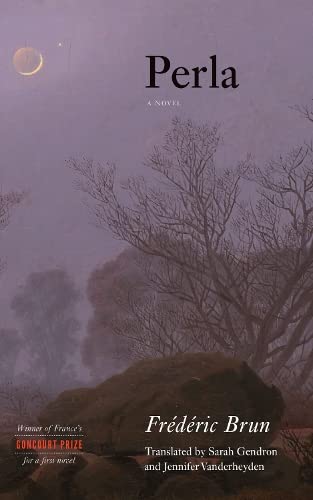
Perla / Frederic Brun ; translated by Sarah Gendron ; translated by Jennifer Vanderheyden.
Material type: TextLanguage: English Original language: French Publisher: Lincoln : University of Nebraska Press, 2017Description: 1 online resourceContent type:
 - text
- computer
- online resource
- 9781496202963
- 1496202961
- Perla. English
- 843/.92 23
- PQ2702.R834
- FIC019000
| Item type | Current library | Collection | Call number | Status | Date due | Barcode | Item holds | |
|---|---|---|---|---|---|---|---|---|
 eBook
eBook
|
e-Library | EBSCO Fiction | Available |
"Perla is the story of a woman who lived through the horrors of the Holocaust and would ultimately die unable to extricate herself from its corrosive memory. It is told from the point of view of her son, who, not long after losing her, learns that he is about to become a father. These two events become the impetus for reconstructing Perla's past and for understanding gestation, as he's equally in the dark about what happened in his mother's life and what is taking place in his wife's womb. Strangely, at this time he finds himself drawn to the poets Novalis, Holderlin, and Schlegel, and the painter Caspar David Friedrich--founders of German romanticism who strove to capture the spiritual essence of the world. With and through them, he seeks peace and grapples with the question: How could Germany produce both the purest poetry and the most complete barbarity? Winner of France's Goncourt Prize for a first novel, Frederic Brun's semiautobiographical novel considers the seemingly irreconcilable multiplicities of life--past and present, personal and collective, self and other, life and death."-- Provided by publisher.
Description based on print version record and CIP data provided by publisher; resource not viewed.
Added to collection customer.56279.3 - Master record variable field(s) change: 072