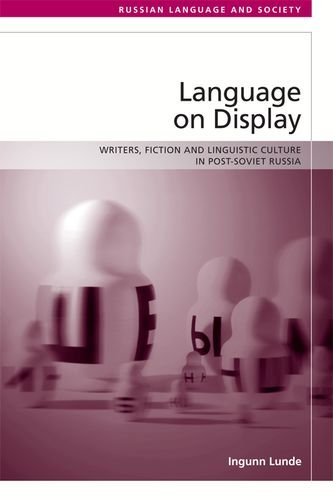
Language on display : writers, fiction and linguistic culture in post-Soviet Russia / Ingunn Lunde.
Material type: TextLanguage: English, Russian Series: Russian language and societyPublisher: Edinburgh : Edinburgh University Press, [2018]Copyright date: ©2018Description: 1 online resource (viii, 222 pages) : illustrationContent type:
 - text
- computer
- online resource
- 9781474421577
- 1474421571
- Writers, fiction and linguistic culture in post-Soviet Russia [Portion of title]
- Linguistic change -- Russia (Federation)
- Language and culture -- Russia (Federation)
- Linguistics -- Russia (Federation)
- Sociolinguistics -- Russia (Federation)
- Russisch
- Literatur
- Sprache Motiv
- Sprachwandel
- Soziolinguistik
- Sprache
- Sprachpflege
- Kultur
- Russland
- Language and culture
- Linguistic change
- Linguistics
- Sociolinguistics
- Russia (Federation)
- POLITICAL SCIENCE / Public Policy / Cultural Policy
- SOCIAL SCIENCE / Anthropology / Cultural
- SOCIAL SCIENCE / Popular Culture
- BIOGRAPHY & AUTOBIOGRAPHY / General
- 306.440947 23
- P40.5.L542 R858 2018eb
| Item type | Current library | Collection | Call number | Status | Date due | Barcode | Item holds | |
|---|---|---|---|---|---|---|---|---|
 eBook
eBook
|
e-Library | EBSCO Biograhpy | Available |
Includes bibliographical references (pages 204-218) and index.
How did Russian writers respond to linguistic debate in the post-Soviet period? Post-Soviet Russia was a period of linguistic liberalisation, instability and change with varied attempts to regulate and legislate language usage, a time when the language question permeated all spheres of social, cultural and political life. Key topics for debate included the Soviet linguistic legacy, the past and future of Russian, linguistic variation, language policy and linguistic ideologies. This book looks at how these debates featured in literature and illustrates the discussion through six interpretive readings of post-Soviet Russian prose. It analyses both the writers' explicit and implicit responses and in doing so opens up new perspectives for sociolinguistic research on metalanguage. Spanning a number of theoretical fields including language variation, language policy and literary stylistics, Ingunn Lunde provides a coherent way of triangulating these fields by the introduction of the concept of performative metalanguage. The book also offers insight into the role of writers in the broader social and political context of language culture in contemporary Russia and into the various ways in which the linguistic and aesthetic practices of literary art can engage in questions related to the negotiation of linguistic norms. Key Features: Highlights the role of writers, and of fiction, in the language debates of post-Soviet Russia, Looks at the subject from the point of view of literary language, discussing six texts in detail.
Text in English and Russian.
pt. I Post-Soviet Language Culture -- 1. Newspeak, Counterspeak and Linguistic Memory -- 2. Challenging the Standard -- pt. II Language, Writers and Fiction -- 3. Languages and Styles of Post-Soviet Russian Prose -- 4. The Literary Norm -- pt. III Writers on Language: Telling and Showing -- 5. Pisateli o iazyke: Writers' Reflections on Language -- 6. Abanamat: Reactions to the Ban on Profanity in Art -- pt. IV Language on Display -- 7. Confronting Linguistic Legacies: Evgenii Popov and Vladimir Sorokin -- 8. Language, Time and Linguistic Dystopia: Tat'iana Tolstaia and Evgenii Vodolazkin -- 9. Language Ideologies and Society: Valerii Votrin and Mikhail Gigolashvili.
Print version record.
Master record variable field(s) change: 072