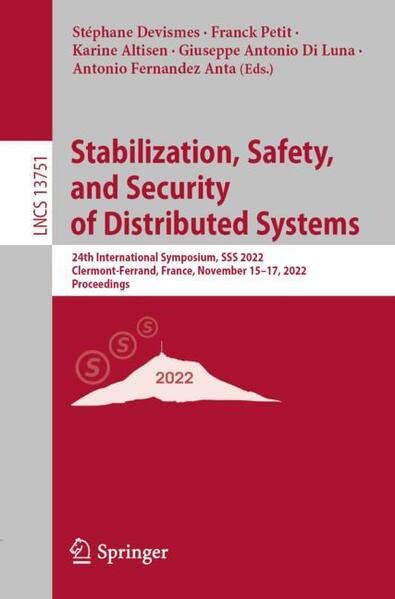
Stabilization, safety, and security of distributed systems : 24th International Symposium, SSS 2022, Clermond Ferrand, France, November 15-17, 2022, proceedings / Stéphane Devismes, Franck Petit, Karine Altisen, Giuseppe Antonio Di Luna, Antonio Fernandez Anta (eds.).
Material type: TextSeries: Lecture notes in computer science ; 13751.Publisher: Cham : Springer, [2022]Copyright date: ©2022Description: 1 online resource (x, 372 pages) : illustrations (some color)Content type:
 - text
- computer
- online resource
- 9783031210174
- 3031210174
- Self-stabilization (Computer science) -- Congresses
- Electronic data processing -- Distributed processing -- Security measures -- Congresses
- Computer security -- Congresses
- Autostabilisation (Informatique) -- Congrès
- Traitement réparti -- Sécurité -- Mesures -- Congrès
- Sécurité informatique -- Congrès
- Computer security
- Electronic data processing -- Distributed processing -- Security measures
- Self-stabilization (Computer science)
- 005.1/4 23/eng/20221116
- QA76.9.S54
| Item type | Current library | Collection | Call number | Status | Date due | Barcode | Item holds | |
|---|---|---|---|---|---|---|---|---|
 eBook
eBook
|
e-Library | eBook LNCS | Available |
Conference proceedings.
Includes author index.
This book constitutes the proceedings of 24th International Symposium, SSS 2022, which took place in Clermont-Ferrand, France, in November 2022. The 17 regular papers together with 4 invited papers and 7 brief announcements, included in this volume were carefully reviewed and selected from 58 submissions. The SSS 2022 focus on systems built such that they are able to provide on their own guarantees on their structure, performance, and/or security in the face of an adverse environment. The Symposium presents three tracks reflecting major trends related to the conference: (i) Self-stabilizing Systems: Theory and Practice, (ii) Concurrent and Distributed Computing: Foundations, Faulttolerance, and Security, and (iii) Dynamic, Mobile, and Nature-Inspired Computing.
Online resource; title from PDF title page (SpringerLink, viewed November 16, 2022).
Intro -- Preface -- Organization -- Contents -- Invited Papers -- Invited Paper: Simple, Strict, Proper, Happy: A Study of Reachability in Temporal Graphs -- 1 Introduction -- 2 Temporal Graphs -- 2.1 Strictness/Properness/Simpleness -- 2.2 Does It Really Matter? (Example of Spanners) -- 2.3 Happy Temporal Graphs -- 3 Expressivity in Terms of Reachability -- 3.1 Separations -- 3.2 Transformations -- 3.3 Summary and Discussions -- 4 More Facts About Happy Temporal Graphs -- 5 Concluding Remarks and Open Questions -- References
Invited Paper: One Bit Agent Memory is Enough for Snap-Stabilizing Perpetual Exploration of Cactus Graphs with Distinguishable Cycles -- 1 Introduction -- 2 Preliminaries -- 2.1 Cactus Graph -- 2.2 Mobile Agent and Graph Exploration -- 3 Snap-Stabilizing Perpetual Exploration -- 3.1 Port Traversal Graph -- 3.2 Algorithm for a Single Agent with One-Bit Agent Memory -- 4 Exploration by an Oblivious Agent -- References -- Invited Paper: Towards Practical Atomic Distributed Shared Memory: An Experimental Evaluation -- 1 Introduction -- 2 Algorithms Overview -- 2.1 ARES -- 2.2 Cassandra -- 2.3 Redis
3 Experimental Evaluation -- 3.1 Experimentation Setup -- 3.2 Scenarios -- 3.3 Experimental Results -- 4 Conclusions -- References -- Invited Paper: Cross-Chain State Machine Replication -- 1 Introduction -- 2 Model of Computation -- 3 State Machines -- 3.1 Example: Simple Swap -- 3.2 Example: Decentralized Autonomous Organization (DAO) -- 4 State Machine Replication Protocol -- 4.1 Path Signatures -- 4.2 Reliable Delivery -- 4.3 Initialization, Moves, and Settlement -- 4.4 Dynamic Funding -- 5 Remarks -- 6 Related Work -- References -- Regular Papers
Plateau: A Secure and Scalable Overlay Network for Large Distributed Trust Applications -- 1 Introduction -- 1.1 Our Contribution -- 1.2 Related Works -- 2 Model and Preliminaries -- 3 The Plateau Network Design and Statement of Results -- 4 Concluding Remarks and Future Work -- References -- The Limits of Helping in Non-volatile Memory Data Structures -- 1 Introduction -- 1.1 Contributions -- 1.2 Related Work -- 2 Characterization of the Crash-Recovery Model -- 3 Process Helping -- 4 Strict-Linearizability vs. Linearization-Helping -- 4.1 Sticky-Bit Object
4.2 An Equivalence Between Linearizability and Strict-Linearizability -- 5 Strict-Linearizability vs. Universal-Helping -- 5.1 Equivalence Between Strict-Linearizability and Universal-Help Freedom -- References -- Treasure Hunt in Graph Using Pebbles -- 1 Introduction -- 1.1 Background and Motivation -- 1.2 Model and Problem Definition -- 1.3 Contribution -- 1.4 Related Work -- 2 Treasure Hunt Algorithm When k<D -- 2.1 D2k < D -- 2.2 k<D2 -- 3 Treasure Hunt Algorithm When kD -- 3.1 Idea of Treasure Hunt in Tree for k=cD Pebbles -- 3.2 Extending the Idea for General Graphs -- 4 Lower Bound