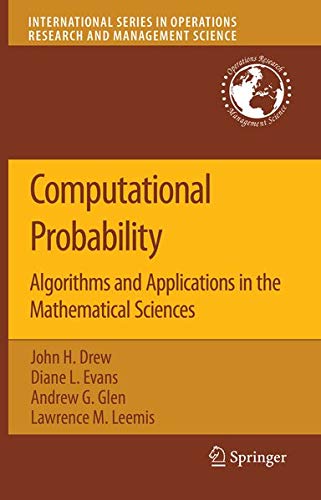
Computational Probability [electronic resource] : Algorithms and Applications in the Mathematical Sciences / by John H. Drew, Diane L. Evans, Andrew G. Glen, Lawrence M. Leemis.
Material type: TextSeries: In Operations Research & Management Science ; 117Publisher: Boston, MA : Springer US, 2008Description: X, 222 p. online resourceContent type:
 - text
- computer
- online resource
- 9780387746760
- Mathematics
- Operations research
- Decision making
- Applied mathematics
- Engineering mathematics
- Computer mathematics
- Probabilities
- Statistics
- Mathematics
- Applications of Mathematics
- Operation Research/Decision Theory
- Probability Theory and Stochastic Processes
- Appl.Mathematics/Computational Methods of Engineering
- Computational Mathematics and Numerical Analysis
- Statistics for Engineering, Physics, Computer Science, Chemistry and Earth Sciences
- 519 23
- T57-57.97
| Item type | Current library | Collection | Call number | Status | Date due | Barcode | Item holds | |
|---|---|---|---|---|---|---|---|---|
 eBook
eBook
|
e-Library | EBook | Available |
Computational Probability -- Maple for APPL -- Algorithms for Continuous Random Variables -- Data Structures and Simple Algorithms -- Transformations of Random Variables -- Products of Random Variables -- Algorithms for Discrete Random Variables -- Data Structures and Simple Algorithms -- Sums of Independent Random Variables -- Order Statistics -- Applications -- Reliability and Survival Analysis -- Stochastic Simulation -- Other Applications.
Computational probability encompasses data structures and algorithms that have emerged over the past decade that allow researchers and students to focus on a new class of stochastic problems. COMPUTATIONAL PROBABILITY is the first book that examines and presents these computational methods in a systematic manner. The techniques described here address problems that require exact probability calculations, many of which have been considered intractable in the past. The first chapter introduces computational probability analysis, followed by a chapter on the Maple computer algebra system. The third chapter begins the description of APPL, the probability modeling language created by the authors. The book ends with three applications-based chapters that emphasize applications in survival analysis and stochastic simulation. The algorithmic material associated with continuous random variables is presented separately from the material for discrete random variables. Four sample algorithms, which are implemented in APPL, are presented in detail: transformations of continuous random variables, products of independent continuous random variables, sums of independent discrete random variables, and order statistics drawn from discrete populations. The APPL computational modeling language gives the field of probability a strong software resource to use for non-trivial problems and is available at no cost from the authors. APPL is currently being used in applications as wide-ranging as electric power revenue forecasting, analyzing cortical spike trains, and studying the supersonic expansion of hydrogen molecules. Requests for the software have come from fields as diverse as market research, pathology, neurophysiology, statistics, engineering, psychology, physics, medicine, and chemistry.