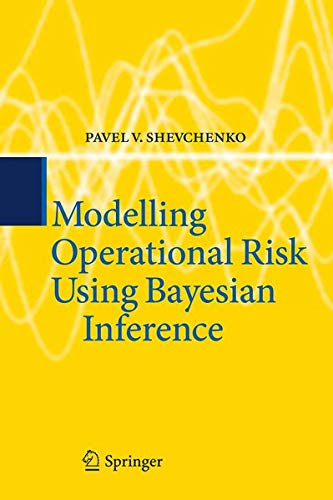
Modelling Operational Risk Using Bayesian Inference [electronic resource] / by Pavel V. Shevchenko.
Material type: TextPublisher: Berlin, Heidelberg : Springer Berlin Heidelberg, 2011Description: XVII, 302 p. online resourceContent type:
 - text
- computer
- online resource
- 9783642159237
- 330.015195 23
- QA276-280
| Item type | Current library | Collection | Call number | Status | Date due | Barcode | Item holds | |
|---|---|---|---|---|---|---|---|---|
 eBook
eBook
|
e-Library | EBook | Available |
Operational Risk and Basel II -- Loss Distribution Approach -- Calculation of Compound Distribution -- Bayesian approach for LDA -- Addressing the Data Truncation Problem -- Modelling Large Losses -- Modelling Dependence -- List of Distributions -- Selected Simulation Algorithms -- Solutions for Selected Problems -- References -- Index.
The management of operational risk in the banking industry has undergone explosive changes over the last decade due to substantial changes in the operational environment. Globalization, deregulation, the use of complex financial products, and changes in information technology have resulted in exposure to new risks which are very different from market and credit risks. In response, the Basel Committee on Banking Supervision has developed a new regulatory framework for capital measurement and standards for the banking sector. This has formally defined operational risk and introduced corresponding capital requirements. Many banks are undertaking quantitative modelling of operational risk using the Loss Distribution Approach (LDA) based on statistical quantification of the frequency and severity of operational risk losses. There are a number of unresolved methodological challenges in the LDA implementation. Overall, the area of quantitative operational risk is very new and different methods are under hot debate. This book is devoted to quantitative issues in LDA. In particular, the use of Bayesian inference is the main focus. Though it is very new in this area, the Bayesian approach is well suited for modelling operational risk, as it allows for a consistent and convenient statistical framework for quantifying the uncertainties involved. It also allows for the combination of expert opinion with historical internal and external data in estimation procedures. These are critical, especially for low-frequency/high-impact operational risks. This book is aimed at practitioners in risk management, academic researchers in financial mathematics, banking industry regulators and advanced graduate students in the area. It is a must-read for anyone who works, teaches or does research in the area of financial risk.