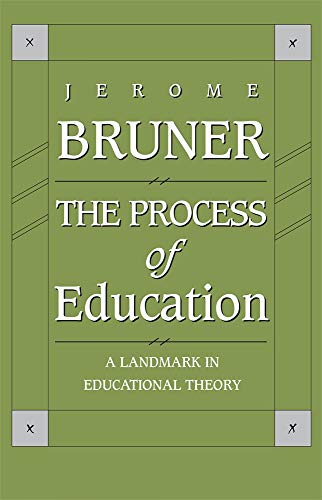
The process of education / Jerome S. Bruner.
Material type: TextSeries: A Harvard paperbackPublisher: Cambridge, Massachusetts : Harvard University Press, [1977]Description: 1 online resource (xxvi, 97 pages)Content type:
 - text
- computer
- online resource
- 9780674028999
- 0674028996
- 9780674710016
- 0674710010
- 9780674710023
- 0674710029
- 370/.1 22
- LB885 .B78 1977eb
- LB 885 B7B7 1977
- 81.51
| Item type | Current library | Collection | Call number | Status | Date due | Barcode | Item holds | |
|---|---|---|---|---|---|---|---|---|
 eBook
eBook
|
e-Library | EBSCO Education | Available |
"A landmark in educational theory"--Cover.
Includes index.
Print version record.
1. Introduction -- 2. The importance of structure -- 3. Readiness for learning -- 4. Intuitive and analytic thinking -- 5. Motives for learning -- 6. Aids to teaching -- index.
English.
Includes index.
In this classic argument for curriculum reform in early education, Jerome Bruner shows that the basic concepts of science and the humanities can be grasped intuitively at a very early age. He argues persuasively that curricula should he designed to foster such early intuitions and then build on them in increasingly formal and abstract ways as education progresses. Bruner's foundational case for the spiral curriculum has influenced a generation of educators and will continue to be a source of insight into the goals and methods of the educational process.